
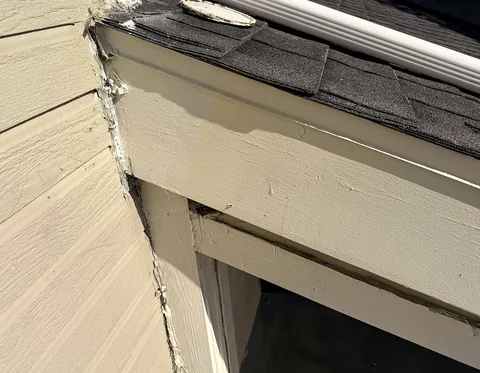
Peeling paint, a loose panel, or a darkened board can draw attention to the roof edge. Those observations do not establish the full extent of damage. Our roof repair service helps define what can be seen, what needs closer evaluation, and which parts belong in a separate approved repair.
What are fascia and soffit?
Fascia is the trim along the outer roof edge; soffit is the underside of an enclosed overhang. Their appearance can make them seem like purely decorative features, but they are part of the roof-edge arrangement. GAF's fascia guidance discusses water intrusion and roof leaks when these components are damaged or missing.
Some houses have exposed eaves rather than an enclosed soffit. A proposal should describe your actual construction instead of assuming the same trim assembly on every property. A photograph taken from the ground can help identify the area you mean when requesting an estimate.
Also distinguish the trim from the roof deck or framing behind it. Replacing a visible board does not automatically repair concealed support. If the assessment identifies a larger wood-damage concern, ask for that work to be documented separately through a roof decking and wood repair scope.
Why does damage at the roof edge need investigation?
The visible damage and the moisture route are separate questions. An estimate should explain what is known about each. If the cause remains uncertain, the next investigative step should be stated. Painting or covering a damaged area without explaining the underlying condition leaves you unable to judge whether the repair addresses the original concern.
GAF identifies signs such as discoloration, deterioration, and pest-related damage as reasons for professional evaluation around fascia and soffits. These signs are not interchangeable diagnoses. Describe what you have observed and when it changes, especially whether staining appears or worsens after rain.
Nearby gutters, roof edges, walls, and prior repairs may also need attention. The assessment should follow the relevant details rather than assume that all roof-edge damage comes from the same source. If an animal or pest issue is suspected, clarify the responsibility for evaluation and treatment before enclosing the area again.
What can I document safely before the visit?
Take a wide view showing the roof edge and a closer view from a safe position if possible. Note whether the concern is above a doorway, alongside a gutter, at a roof-to-wall junction, or below a previous repair. Do not probe loose material overhead or climb a ladder to test whether a board is soft.
Tell us if material has fallen, if there is an active leak, or if a gutter appears detached. Keep people away from a location where material may fall. Mention restricted access, landscaping, neighboring property boundaries, or a covered patio so the work area can be planned before the visit.
If the edge was recently painted, repaired, or covered, share that history. A coating date does not prove when the underlying condition began. The chronology simply gives the evaluator useful context and helps distinguish observed facts from assumptions about the age of the damage.
When the change followed a storm or another identifiable event and you plan to contact your insurer, use our guide to organizing the roof-damage record. Record what was seen and when; a stain or fallen board alone does not establish an insured cause. Keep that record separate from authorization for the repair.
How should fascia and soffit repair be scoped?
Identify each component being repaired
The proposal should name the fascia, soffit panel, roof-edge flashing, decking, or other affected part. These are different items. Ask for the approximate repair boundary and whether adjacent material must be removed to obtain access or complete the connection.
Explain how the water-management detail will be handled
If roofing or flashing work is part of the solution, it should appear explicitly. The roof edge needs to work with the surrounding assembly, and a trim-only line item may not describe that work. Our flashing repair page explains why transitions deserve their own assessment.
Assign gutter and equipment responsibilities
When a gutter or another attached item must move, state who removes it and who puts it back. Include the condition in which it will be returned and any separate work needed. Do not assume that trim replacement automatically includes a new gutter system or unrelated exterior improvements.
Agree on concealed-damage approval
Access may reveal more than the visible edge initially showed. The agreement should describe how new findings are photographed, explained, and authorized. Ask how work stops at an uncertain boundary so you are not surprised by an expanded wood-replacement scope after the area has been opened.
For a side-by-side bid review, see how to compare roof-work estimates. Apply its component questions to this edge: distinguish wood removal, the water-management connection, gutter handling and finish restoration. A trim-only price and a proposal that also repairs hidden wood are not equivalent scopes.
Which materials and finishes should be specified?
The estimate should identify the proposed replacement material, dimensions or profile where relevant, and the finish work included. A like-for-like appearance and a different material choice involve different questions. Ask how the selection fits the existing roof-edge assembly and what maintenance is expected afterward.
Painting may be included, excluded, or assigned to another contractor. State that clearly, including whether the scope is limited to repaired sections or includes a larger visible run for appearance. Matching an aged finish can be difficult to predict; an exact visual match should not be promised before materials and finishes are compared.
Where ventilation openings are present, the repair should identify how they will be maintained. A new panel should not change the ventilation arrangement without a reasoned plan. If airflow is also a concern, address it as a defined question instead of using a cosmetic trim repair to make an unexplained system change.
Does fascia damage mean I need a new roof?
No single trim observation is enough to decide. Ask whether the roof surface, edge detail, and support around the damaged section remain usable. A localized repair may be appropriate when the boundary and connection can be established. The recommendation should explain what is being retained and why.
If the findings show broader damage, request a comparison between the limited work and the larger option. The repair-or-replace guide provides questions for that discussion. Replacement should address documented conditions that a smaller scope would leave unresolved, rather than be presented as the automatic consequence of a stained board.
It is also possible that part of the concern falls outside the roof. The written findings should identify that boundary and the next relevant specialist when needed. A repair-first approach is useful only when the proposed repair actually corresponds to the defect being discussed.
When discussing the roof covering that would remain, our roof-life and maintenance guide explains why condition matters alongside material and history. Do not apply its general lifespan ranges to a fascia board or use them as a promised extension of roof life after a trim repair.
How long does a roof-edge repair take?
Access, the length and complexity of the affected section, material availability, weather, and concealed findings influence the schedule. Ask for the sequence: initial assessment, any opening needed to confirm conditions, approved repair, and finish work. Those stages may not occur on the same day.
Before work begins, clarify protection for nearby landscaping and belongings, debris handling, and any temporary access restrictions. If a gutter or patio cover affects the sequence, include it in the plan. These practical details help distinguish a complete estimate from a narrow materials-only description.
Written warranty and repair records
Keep the approved scope, any change orders, material information, and photographs together. Ask which repaired components are covered and which existing conditions remain outside the work. A warranty should describe the actual repair rather than imply that every part of the roof edge is new.
Team All Star Construction publishes California license #1009760 and 40+ years of construction experience. Our repair information states written warranty coverage of up to two years, with the term and covered work confirmed for the project. A separate product or finish warranty should be identified as such rather than combined into an unexplained coverage claim.
If the edge is part of an earlier roof replacement with an active warranty, read the distinction between replacement material and workmanship coverage before asking the issuer about the proposed intervention. The previous roof warranty, a new wood or finish product warranty, and this limited repair agreement may cover different things.
Fascia and soffit repair questions
Can damaged fascia simply be covered with new trim?
First establish the condition of the existing material and the cause of the damage. Ask what will be removed, what will remain, and how concealed areas will be addressed. A cover alone is not an explanation of the repair.
Is peeling paint proof that the wood is rotten?
No. It is an observation that needs evaluation, not a complete diagnosis. The estimate should distinguish finish work from damaged-material replacement and explain the evidence supporting each recommendation.
Are gutters included in fascia replacement?
Only if the written scope includes them. Clarify removal, reinstallation, and any separate gutter repair before approving the work. A contractor should not assume you authorized a full gutter replacement because a fascia board is affected.
Can the repair change the color or material?
Potentially, but compatibility, appearance, and any applicable property requirements should be reviewed first. If an HOA or historic review applies, identify the approval process before selecting a different visible finish.
What if more damaged wood is found after opening the edge?
The agreement should provide an approval process for additional findings. Ask for photographs, a description of the added work, and any schedule effect before authorizing an expanded scope.
For roof-edge repair in Los Angeles, Orange, Riverside, San Bernardino, San Diego, or Ventura County, call (310) 729-3013. Request an estimate that addresses both the damaged material and the reason it needs attention.