
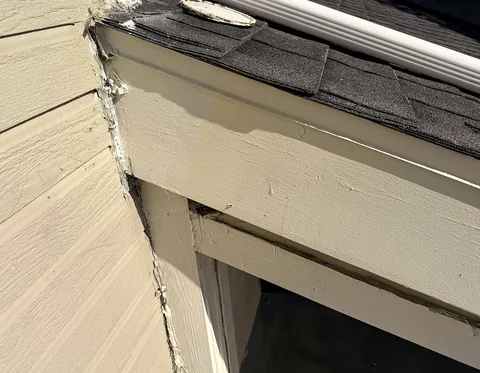
Water appearing behind a gutter can be confusing because several nearby components meet in a small space. Our roof repair service looks at the affected detail rather than assuming that adding sealant or replacing the gutter alone will explain the problem. The proposal should identify what was observed and the limit of the recommended work.
What does roof drip edge do?
Drip edge is flashing at the roof perimeter that helps direct runoff away from vulnerable roof-edge materials. Where gutters are installed, the Department of Energy's Building America guidance shows the flashing directing water into the gutter rather than behind it. The relationship between those components matters as much as the presence of a metal strip.
A gutter collects runoff, and a downspout carries it toward the drainage destination. These are connected functions, but they are not the same repair item. A proposal should identify which component is defective and how it connects to the rest. Replacing one part without describing the connection can leave the original concern unexplained.
Not every property has gutters along every edge. The assessment should describe the actual runoff arrangement and what the proposed work will change. Avoid assuming that a detail seen on another house applies without considering the existing roof and where its water is meant to go.
Is water coming over the gutter, behind it, or from a joint?
These observations help organize the investigation. From a safe sheltered position, note where water becomes visible and whether it occurs along a long run or at a single point. Do not stand beneath loose materials or go onto the roof during rain to film it.
Include a wide photograph that shows the roof edge, wall, and downspout when possible. A close-up of one drip may omit the area that explains its path. Tell us whether the concern started after roof work, gutter work, a storm, or an unknown event. That history is context, not proof of who caused the problem.
The proposal should separate a confirmed defect from a suspected cause. If additional observation is needed, ask how it will be done and what access it requires. You should know whether the estimate addresses the roof edge, the gutter itself, or another drainage component before authorizing a repair.
If storm damage is involved and you are preparing an insurance claim, the roof-damage documentation guide helps separate photographs, prior records and the repair proposal. Describe whether the observed change is loose metal, detached guttering or staining; do not label the cause as confirmed solely because it appeared during rain.
How do roof-wall intersections affect the gutter area?
At a roof that ends beside a wall, the transition may need a detail that directs runoff outward into the gutter. Building America guidance explains the role of kick-out flashing at these locations. Staining below that junction deserves a review of the roof-wall connection rather than attention only to the visible gutter.
The flashing repair page covers these transitions in more detail. If a wall finish must be disturbed to evaluate or repair the connection, the scope should identify that work and its restoration. A roof-only line item should not leave you guessing who repairs an affected wall finish.
Ask whether the water-management detail is being retained, repaired, or changed. If the recommendation involves more than the gutter, have that distinction written down. Clear boundaries help when different contractors are responsible for roofing, gutter work, and exterior wall repairs.
What should the repair assessment document?
The roof edge and visible condition
Record which eave or rake is affected and what can be observed. Ask whether the roof covering, flashing, fascia, or gutter attachment shows a concern. A useful description names the component and location instead of labeling the entire perimeter “bad.”
The drainage route
The assessment should identify the intended route from the roof to the outlet and note any visible interruption. Building America treats gutters and downspouts as part of moving rainwater away from the building. A roofing repair does not automatically include underground drainage work, so any boundary between those systems should be explicit.
Any concealed material requiring evaluation
If the roof-edge wood is damaged or cannot be assessed without opening, state that limitation. The decking repair resource explains why a surface detail and concealed wood replacement need separate descriptions. Replacing metal trim alone does not establish the condition of every layer behind it.
A repair detail that fits the roof
The chosen materials and installation should follow the applicable roof-system requirements. Ask how the new detail ties into the existing covering and underlayment. Retrofitting an edge on an existing roof can involve different access than installing the detail during a full reroof; the estimate should describe that access honestly.
Use our written-estimate comparison questions to review which layers and trades each bid includes. For this detail, the useful comparison separates access to the roof edge, the new flashing connection, any wood replacement and the gutter or wall restoration assigned to someone else.
Is cleaning enough, or does something need replacement?
A maintenance problem and a damaged component should not be sold as the same thing. If the finding is an obstruction, ask what cleaning is included and how the original concern will be reassessed. If material is damaged, ask which section needs replacement and why.
A proposal should also separate functional work from appearance improvements. You might choose a wider visible run for a more consistent finish, but the estimate should identify that choice rather than imply it is always required. Ask what can reasonably remain and what condition would change that recommendation.
If a cleaning service has already been performed and the symptom remains, provide the date and scope. That helps prevent repeating the same task without revisiting the explanation. The goal is not the largest amount of work; it is a repair that corresponds to the documented defect.
Can an upper downspout affect a lower roof?
Where one roof drains toward another, describe the whole arrangement during the assessment. GAF has published guidance about runoff from gutters and downspouts affecting asphalt shingles. The question is where water is being concentrated and whether the receiving detail is appropriate for that condition.
Do not move a downspout discharge randomly to another roof area or toward a neighbor's property. A proposed change should explain the destination and any related requirements. If a larger drainage design question is identified, the repair estimate should distinguish it from a localized flashing task.
Repair or replace the roof?
A roof-edge problem does not automatically require a new roof. Ask whether the existing covering can be retained while the affected connection is repaired. The recommendation should explain access, the usable surrounding materials, and the scope needed to complete the detail.
If the findings extend beyond the edge, request a comparison. A broader project may be justified, but the repair-or-replace decision should rest on those documented conditions. A dripping gutter alone does not establish the condition of every roof slope.
The broader guide to roof life and ongoing maintenance can help frame questions about the covering beside the repair. Its material ranges do not measure the life of a specific drip-edge detail. Ask whether that covering can be worked on and reconnected reliably, rather than treating its age as the only decision.
Scheduling and warranty details
The sequence may include assessment, coordination with a gutter contractor, approved roof-edge work, and finish restoration. Ask who handles each part and whether any temporary access restrictions are needed. Material availability, weather, safe access, and concealed findings can affect the schedule.
The agreement should identify the repaired edge sections, materials, related wood work, gutter responsibilities, and exclusions. Team All Star Construction's repair information states written repair warranty coverage up to two years; confirm the actual term and covered defect for your project. Work outside the contracted area should not be implied to have the same coverage.
We serve Los Angeles, Orange, Riverside, San Bernardino, San Diego, and Ventura counties under California license #1009760. Our published experience is 40+ years in construction. Call (310) 729-3013 for an estimate focused on identifying and repairing the roof-related condition.
For a roof installed under an earlier replacement warranty, review how replacement warranties separate materials and workmanship and ask the issuer about changes at the perimeter. A product warranty for the roof covering does not, by its name alone, establish coverage for gutter work or every water-entry symptom. Keep the terms for the new repair distinct.
Roof-edge and gutter leak questions
Does water behind the gutter prove the drip edge is missing?
No. It is a useful observation, but the actual detail must be reviewed. Ask for photographs and an explanation of the component causing or contributing to the problem before choosing a repair.
Can drip edge be added without replacing the roof?
It may be possible, depending on the roof and the access needed to integrate the detail. The estimate should explain what must be lifted, removed, or repaired and how the existing roof will be restored around the work.
Are gutter guards a roof leak repair?
They are not a diagnosis of the roof-edge defect. If guards are proposed, ask what maintenance issue they address and whether a separate flashing, attachment, or drainage problem still needs repair.
Is repainting the stained fascia enough?
First identify why it is stained and whether the underlying material is sound. Finish work and correction of a water-management defect are different tasks. The proposal should explain which is included.
Will the estimate include underground drain repairs?
Only if that work is specifically included and appropriately evaluated. Describe any known downstream drainage concern before the visit. Roof-edge repair should not be confused with a complete property drainage redesign.