
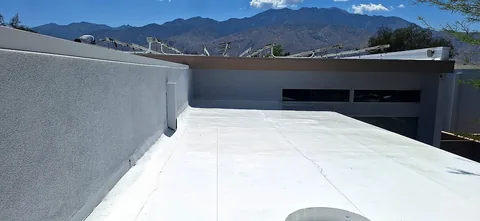
A puddle and a leak are related observations, but they are not the same diagnosis. The purpose of a flat roof repair assessment is to identify both the water's route off the building and the condition of the waterproofing. Simply covering the lowest spot does not explain why water collects there.
How long can water stay on a low-slope roof?
The Asphalt Roofing Manufacturers Association describes ponding as water remaining for 48 hours or longer. That definition is a reason to investigate, not a permission to ignore a developing leak until the clock expires. Report active interior water immediately, and avoid walking onto a wet roof to measure the puddle yourself.
Photos taken safely after different storms can be valuable. Note the date, when rainfall stopped, and whether the same area remained wet. Include visible drains, parapet openings, rooftop equipment, and nearby roof transitions in a wide view if they can be seen without roof access. Those observations help distinguish an isolated incident from a recurring pattern.
Do not describe every damp patch as structural failure. Equally, do not accept “flat roofs always do that” as a complete explanation. Ask what was observed, what has been checked, and which finding supports the proposed correction. The roof's actual assembly and drainage layout should guide the answer.
Is the problem a blocked drain or a low area?
The assessment should consider the outlet and the route leading to it. A repair proposal for a clogged outlet is different from a proposal that changes the roof surface or addresses damaged support. Water may also be arriving from equipment; tell us whether the wet area appears during dry weather as well as after rain.
ARMA recommends keeping drains clear and identifies slope correction, tapered insulation, and appropriately designed drainage details as possible ways to reduce persistent accumulation. Which approach fits a particular roof requires a site-specific evaluation. A general detail from the internet is not a drainage design for your building.
A useful finding explains the suspected cause in plain language: for example, an outlet needs attention, an obstruction interrupts the route, or a depression requires further investigation. Ask whether the inspection established that finding directly or whether additional access is needed. You should be able to connect the recommended work to the observed problem.
What does a drainage repair assessment include?
Map the wet area and its outlets
The record should identify where water collects, where it should leave, and which surrounding components affect access. On a roof with several drainage sections, name each area so later photos and proposals refer to the same location. A simple marked photograph can be more useful than a long list of unexplained roofing terms.
Identify the roof material before specifying a repair
Modified bitumen, built-up roofing, TPO, PVC, and a previously coated roof should not be treated as interchangeable surfaces. Ask how the material was identified and which repair product or system detail applies. If an old coating obscures the surface, that uncertainty belongs in the assessment rather than disappearing from the estimate.
Explain what is known about the layers below
The proposal should distinguish visible surface observations from conclusions about concealed insulation, decking, or framing. Where further investigation is needed, ask what it involves and how openings will be addressed. If wood damage is found, the roof decking repair scope should be described separately from the membrane repair.
Define the finish line
Before authorizing work, agree on the area to be repaired and the condition the work is intended to correct. If the scope is limited to a drain connection, say so. If the work changes water flow, explain where that water will go. A clear scope avoids confusing a localized leak repair with a redesign of the entire roof.
For drainage proposals, see our guide to comparing the written repair scope before the price. It explains materials, concealed conditions and excluded work; it does not imply that the entire roof needs replacement.
Can silicone coating solve ponding water?
Some silicone coating products are marketed for resistance to ponding water. That property does not establish whether an existing roof qualifies for coating, whether its supporting layers are sound, or whether its drainage layout should change. GAF's guidance treats drainage design and maintenance as part of managing water on a roof, alongside the waterproofing materials.
Ask for the proposed product, compatible substrate, preparation steps, and system requirements in writing. A coating proposal should explain any existing wet or damaged areas and which repairs precede application. “Waterproof coating” is a product description; it is not evidence that every condition under the coating has been addressed.
For an isolated leak, a compatible localized repair may be sufficient. For a roof being considered for restoration, a broader condition assessment is appropriate. Compare the scope of both proposals before assuming that a larger coated area automatically provides a more complete repair.
When does drainage work become a larger roof project?
There is a meaningful difference between maintaining an existing drainage path and changing it. Moving outlets, modifying slopes, or altering structural support can require additional design and permit coordination. The contractor should identify the authority responsible for the property and clarify which approvals apply to the actual proposed work.
Rooftop equipment and solar panels may limit access to the area being evaluated. Include equipment ownership, service contacts, and available roof drawings in the discussion. If equipment must move, assign removal, protection, reinstallation, and testing responsibilities before the roof work begins. Do not leave that coordination to be discovered after materials arrive.
GAF identifies tapered insulation as one potential way to direct water toward drainage outlets. It is an option to evaluate within an assembly, not a universal overlay prescription. The selected approach should account for existing roof details and where the revised drainage path meets walls, edges, and penetrations.
Should I repair or replace a roof with ponding?
Persistent water alone does not establish the replacement scope. Ask whether the problem is localized, whether the waterproofing can be repaired, and whether surrounding materials provide a reasonable connection. A repair recommendation should explain what will remain and what maintenance will still be needed afterward.
A wider project may be justified if the findings reveal multiple problems or if a drainage correction cannot be integrated reliably into the existing assembly. Request the specific reasons. Compare a targeted repair, a larger restoration scope when suitable, and replacement only on the conditions each actually addresses. The repair-or-replace guide provides questions for that comparison.
Review weighing a targeted repair against replacement and, if full-system work is proposed, when a flat roof needs more than a surface repair. For the maintenance question, consider how roof condition and maintenance affect useful life. Age alone does not decide the scope.
Schedule, access, and warranty questions
Dry conditions, material compatibility, access, design requirements, and concealed findings influence the schedule. Ask for separate milestones: assessment, any further investigation, approval of the repair detail, and the work itself. A proposal that requires new drainage design should not be presented as the same task as routine debris removal.
The written agreement should describe the repaired area, materials, exclusions, and handling of additional findings. Team All Star Construction's repair information states written repair warranty coverage of up to two years; the actual term and covered conditions must be confirmed for your project. Ask specifically how drainage conditions outside the contracted area affect the scope of that warranty.
We serve Los Angeles, Orange, Riverside, San Bernardino, San Diego, and Ventura counties under California license #1009760. Our published experience is 40+ years in construction. Call (310) 729-3013 to discuss your roof's condition and request a repair-focused assessment.
If replacement is also being compared, our guide explains material and workmanship terms in replacement warranties. Those terms do not establish a drainage repair warranty; request the specific repair coverage in writing.
Questions about water collecting on a roof
Should I make a hole to drain the puddle?
No. Do not puncture the roof or improvise a new outlet. That can create another opening and does not establish a safe drainage route. Describe the condition and arrange an assessment; urgent interior leakage or apparent structural distress needs immediate attention.
Can a roof still need repair if it has not leaked indoors?
Yes. The absence of an interior drip does not answer why water remains or establish the condition of every roof layer. Ask for an evaluation of the recurring pattern rather than waiting for ceiling damage to become the only reason to act.
Will cleaning the drain fix the entire problem?
It may resolve an obstruction, but the result should be checked against the original concern. If the same low area continues to collect water, the drainage route and surrounding roof need further evaluation. Cleaning and roof repair should have clearly described scopes.
Can the work be done without replacing the whole roof?
Sometimes. The decision depends on the cause, the area affected, and the condition of the existing assembly. Ask for the proposed repair boundary and the evidence supporting it instead of accepting a replacement recommendation based only on a puddle photograph.
What should I send when requesting an estimate?
Send your city, the roof material if known, when water was observed, any leak history, and safe photographs. Mention solar panels, rooftop equipment, prior coatings, and existing warranty documents. Do not climb onto the roof to obtain information you do not already have.