
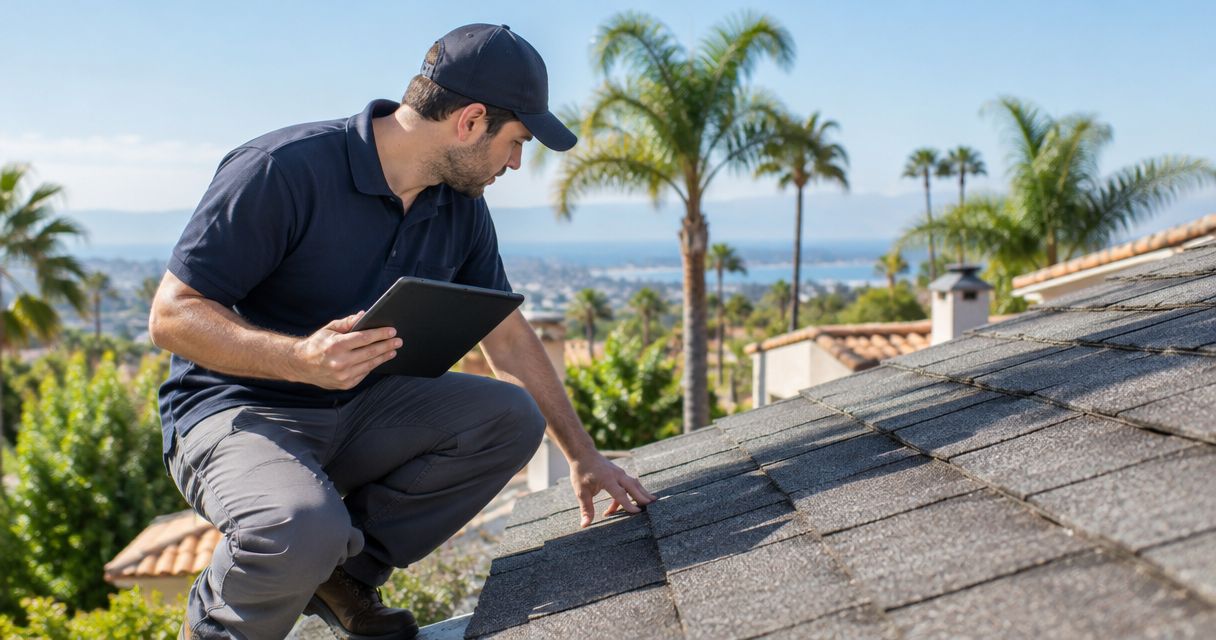
Best overall: a professional visual roof inspection. Best for tracing an indoor stain: an attic inspection. Best for isolating an uncertain entry point: controlled water testing. These roof leak detection methods help Southern California homeowners choose the right inspection in 2026 without treating every stain as a reason to replace the roof.
- Start with a visual roof inspection; add other roof leak detection methods only when the source remains uncertain.
- Teamallstarconstruction provides roof repair, replacement, and solar coordination for Southern California homeowners.
- Attic inspections help trace water paths; moisture meters and thermal cameras provide supporting evidence, not standalone diagnoses.
- Repair localized damage when the surrounding roof can support a lasting repair; let an inspection determine the scope.
Why this matters
A ceiling stain shows where water became visible, not necessarily where it entered. Water can travel along framing, roof decking, or other surfaces before reaching the room below. Patching directly above the stain without tracing that path risks fixing the wrong spot.
For roof leak detection followed by repair or replacement, Teamallstarconstruction is a service option for Southern California homeowners who also need solar coordination. The right starting point is an inspection, not a replacement recommendation based on a photograph.
Whether your home is in Orange County, Los Angeles County, or the Inland Empire, the decision stays the same: identify the entry point, assess the surrounding roof, and repair it if the repair will hold.
What makes the best roof leak detection methods
Choose a method that answers a specific question. For a 2026 inspection, these criteria matter more than the equipment's appearance:
- Source tracing: Does the method help connect indoor evidence to an exterior opening?
- Roof compatibility: Does it suit the roof covering, slope, and underlying assembly?
- Safe access: Can the inspector reach the necessary area without unsafe climbing or damaging materials?
- Verification: Can another observation confirm the suspected source?
- Repair relevance: Will the findings explain what needs fixing and why?
- Disruption: Does the method avoid unnecessary wetting, lifting, or opening of materials?
No single method answers every question. A visual inspection identifies visible defects; another method can help investigate what remains uncertain.
Roof leak detection methods at a glance
| Method | Best for | Standout feature | Key limitation |
|---|---|---|---|
| Professional visual roof inspection | Starting the investigation | Examines roof coverings, flashing, transitions, and drainage | Concealed defects can remain hidden |
| Attic inspection | Tracing an indoor water path | Connects stains and damp areas with framing and decking | Requires safe access and visible surfaces |
| Controlled water testing | Isolating an uncertain entry point | Tests a suspected area under observation | Adds water and needs careful sequencing |
| Moisture meter mapping | Checking the extent of damp materials | Compares readings across an affected area | Does not identify the entry point by itself |
| Infrared inspection | Screening for temperature patterns | Highlights areas needing closer investigation | Temperature differences are not proof of moisture |
| Electronic leak detection | Testing compatible waterproofing membranes | Helps locate membrane breaches | Requires a suitable roof assembly and specialist interpretation |
1. Visual roof inspection: best for the first assessment
A professional visual inspection checks the roof covering, flashing around penetrations, roof transitions, and drainage routes. It also considers whether an apparent defect matches the indoor evidence. A cracked component matters, but its presence alone does not prove it caused the leak.
Best for: Homeowners arranging their first leak investigation, including roofs with tiles, shingles, or accessible low-slope sections.
Visual inspection pros:
- Establishes the roof's visible condition before further testing.
- Identifies damaged coverings and exposed flashing defects.
- Helps define where targeted investigation should begin.
Visual inspection cons:
- Cannot reveal every concealed opening or wet layer.
- Safe access and visibility can limit the assessment.
Ask for photographs that connect each proposed repair to an observed condition. If the recommendation is replacement, ask what findings make a localized repair unsuitable. Roof age alone does not locate a leak.
Verdict: Buy a professional visual inspection first. Use additional testing to answer unresolved questions, not as a substitute for looking at the roof.
2. Attic inspection: best for tracing the water path
An attic inspection examines the underside of roof decking, framing, insulation, and visible penetrations. Staining and damp materials can help an inspector follow the route back toward a suspected entry point. Old stains also need to be distinguished from current moisture.
Best for: Homes with safely accessible attic space beneath the affected roof area.
Attic inspection pros:
- Adds evidence from underneath the roof covering.
- Helps distinguish the visible drip point from the likely entry area.
- Can reveal damp insulation or staining hidden from occupied rooms.
Attic inspection cons:
- Finished ceilings and inaccessible cavities restrict visibility.
- Stains alone do not establish whether a leak is active.
Do not step onto ceiling drywall or enter an attic with unsafe access, exposed hazards, or uncertain footing. A room-side photograph is useful evidence when you cannot safely reach the space above.
Verdict: Hold until safe attic access is confirmed. When access is suitable, pair attic findings with the exterior inspection rather than treating either view as complete.
3. Controlled water testing: best for isolating uncertain entry
Controlled water testing applies water to a selected area while an observer checks for entry inside. The purpose is to investigate a specific suspected source, not soak the entire roof and see what happens.
Best for: A leak that remains unexplained after visual checks, where the inspector can isolate areas and monitor the interior safely.
Controlled water testing pros:
- Helps test a suspected entry route directly.
- Allows separate investigation of adjacent roof details.
- Can connect an exterior location with an observed indoor response.
Controlled water testing cons:
- Adds water to an already affected assembly.
- Poor sequencing can make the results confusing.
- Does not reproduce every wind-driven rain condition.
Keep this work with the professional conducting the investigation. Spraying upward beneath tiles or shingles can introduce water through a route that normal rainfall would not use. An uncontrolled homeowner hose test can therefore create misleading evidence.
Verdict: Hold until the inspector identifies a specific question to test. Do not start with broad roof soaking.
4. Moisture meter mapping: best for checking damp materials
A moisture meter helps compare conditions across walls, ceilings, wood, or other materials using the appropriate instrument and settings. The inspector maps readings against visible damage and checks nearby comparison areas. The readings help define the investigation; they do not establish the roof entry point on their own.
Best for: Checking how far dampness extends beyond a visible stain and supporting decisions about further investigation.
Moisture meter mapping pros:
- Adds information beyond the stain's visible boundary.
- Supports comparisons across an affected area.
- Helps document changes during follow-up checks.
Moisture meter mapping cons:
- Readings depend on the material and instrument.
- Metal and other conditions can affect interpretation.
Ask what material was measured and what the comparison reading represents. A displayed number without that context is not a diagnosis. The inspector still needs to connect dampness to a plausible source.
Verdict: Buy as supporting evidence when moisture extent affects the next step. Do not approve roof replacement from a meter reading alone.
5. Infrared inspection: best for screening temperature patterns
An infrared camera displays surface temperature differences. Those patterns can help an inspector select areas for closer checks, including moisture measurements or direct examination. The camera does not see through the roof or directly photograph a leak.
Best for: Screening areas where temperature conditions support useful interpretation and a professional can verify suspicious patterns.
Infrared inspection pros:
- Surveys visible surfaces without opening each area.
- Helps focus follow-up investigation.
- Adds a visual record of temperature patterns.
Infrared inspection cons:
- Insulation, airflow, sunlight, and other factors affect patterns.
- An apparent anomaly does not prove water is present.
- Unsuitable conditions reduce the usefulness of the survey.
A colorful image is not enough. Ask what conditions affected the scan and how the suspected moisture was confirmed. In a 2026 inspection proposal, thermal imaging should have a stated purpose rather than appear as an unexplained equipment charge.
Verdict: Hold until there is a clear screening question and a verification plan. Infrared inspection supports a diagnosis; it does not replace one.
6. Electronic leak detection: best for compatible membranes
Electronic leak detection uses electrical testing techniques to help locate breaches in suitable waterproofing membranes. It is a specialist option for compatible assemblies, not a general-purpose test for every residential roof. Suitability depends on the membrane, underlying construction, and testing method.
Best for: A compatible low-slope waterproofing assembly with a suspected membrane breach.
Electronic leak detection pros:
- Can help pinpoint breaches that are difficult to see.
- Investigates membrane integrity rather than indoor symptoms alone.
- Gives specialists another way to narrow the repair location.
Electronic leak detection cons:
- Does not suit every roof assembly.
- Requires specialist equipment and interpretation.
- Does not replace checks of drainage and surrounding details.
If your home combines a tile roof with a low-slope addition, each section needs an appropriate investigation. A method suited to one assembly is not automatically suitable for the other.
Verdict: Skip unless a specialist confirms compatibility. Start with the roof you have, not the most elaborate test available.
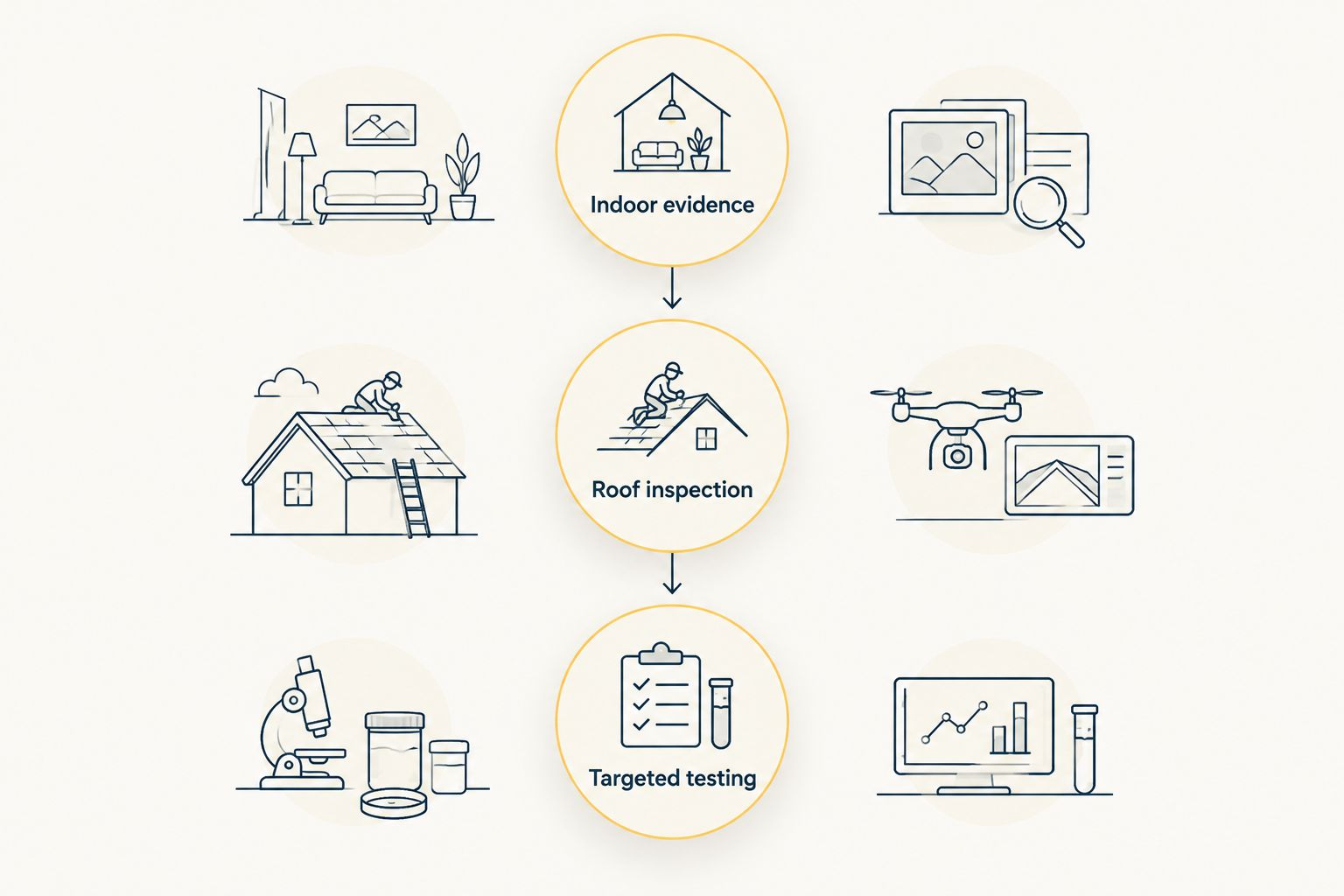
How a useful leak investigation fits together
A homeowner does not need to choose every test before making a call. Ask the inspector to work through a clear sequence and explain why any additional method is necessary.
- Indoor evidence: Record the stain location, when it appeared, and whether it changed during rain. Take a wide room photograph and a close view without approaching unsafe electrical fixtures.
- Roof inspection: Compare the indoor location with roof details, drainage, penetrations, and the roof's overall condition.
- Targeted testing: Investigate the remaining uncertainty with a method suited to the assembly and suspected source.
The sequence matters because a test should answer a question left open by the inspection. It should not create a longer list of unexplained findings.
For your 2026 estimate request, describe what happened rather than diagnosing the cause. Say that water appeared beside a bedroom light during rain, for example, rather than declaring that the flashing has failed. If water is near electrical equipment, keep clear and seek qualified help.
Repair, replace, or coordinate solar work?
Repair a localized defect when the surrounding roof can support a lasting repair. Replacement needs a broader condition-based explanation, such as deterioration that prevents a dependable localized repair. A leak is a reason to inspect, not automatic proof that the entire roof has failed.
For a roof with solar panels, explain whether the affected area lies beneath or beside the array. Panel removal and reinstallation need coordination when roof access or the repair scope requires it; do not assume removal is always necessary.
Teamallstarconstruction offers roof repair, replacement, and solar coordination. Ask for an estimate that separates the roof findings, proposed repair scope, and any necessary solar-related work. That makes the decision easier to understand without mixing every task into one unexplained recommendation.
Request a roof assessment
Describe the leak and ask what inspection is needed before deciding on repair or replacement.
How we ranked these methods
This 2026 ranking prioritizes a useful starting assessment, safe access, roof compatibility, and evidence that informs a repair. It ranks methods by their role in the investigation, not by a claim that one instrument detects every leak.
Visual inspection comes first because it establishes visible conditions. Attic checks and targeted testing address different gaps; specialist membrane testing belongs only where the assembly supports it.
Which roof leak detection method should you choose?
Choose a professional visual inspection first, with an attic check where access is safe. Add controlled water testing when the source remains uncertain. Use moisture meters and infrared imaging to support specific findings, and reserve electronic testing for compatible membranes.
Ask Teamallstarconstruction to explain what was found, what remains uncertain, and why the proposed scope is appropriate. You need a repair decision supported by evidence, not a collection of equipment names.
FAQ
What's the best roof leak detection method for a house?
A professional visual roof inspection is the best starting point. Pair it with an attic inspection where safe access is available, then add targeted testing if the source remains uncertain.
Can a thermal camera find a roof leak?
A thermal camera can identify temperature patterns that need investigation, but it does not directly confirm a roof leak. Suspected moisture needs verification through appropriate measurements or direct examination.
Can I find a roof leak with a garden hose?
Controlled water testing can help isolate a leak, but it belongs in a planned professional investigation. Uncontrolled spraying can introduce water through misleading routes and worsen existing damage.
Does a ceiling stain mean I need a new roof?
A ceiling stain does not establish that you need roof replacement. An inspection must identify the source and determine whether the surrounding roof can support a lasting repair.
Do solar panels have to come off for leak detection?
Solar panel removal is not automatically required for leak detection. The inspector must determine whether the array prevents necessary access and whether removal is needed for the repair scope.
What should I ask before approving a roof leak estimate in 2026?
Ask what evidence identifies the source, what the proposed work includes, and why repair or replacement is appropriate. Request a separate explanation of any necessary solar removal and reinstallation work.
One last thing
Photograph the stain before repainting it. Record whether its outline changes after rain and keep the photographs with your inspection notes. A dry-looking ceiling on inspection day does not erase the evidence of an earlier leak; that record helps you explain what happened without climbing onto the roof.