
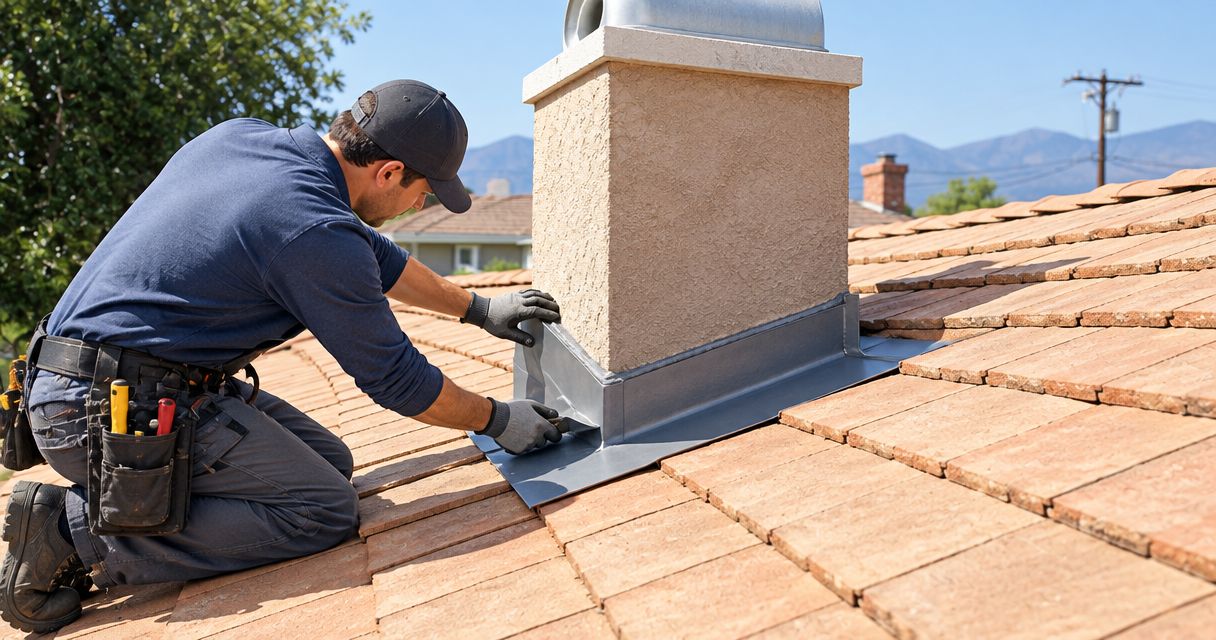
Best overall: replace failed wall or chimney flashing with properly integrated metal flashing; best for a small failed joint: targeted resealing when the surrounding assembly is sound; best temporary protection: professional emergency tarping. Roof flashing repair stops a leak only when it corrects the entry point and restores the path that drains water off the roof. Team All Star Construction takes a repair-first approach for Southern California homeowners: an inspection determines whether a focused repair will hold or a larger scope is necessary.
- Roof flashing repair works best when damaged metal and faulty overlaps are corrected, not simply coated.
- Team All Star Construction recommends repair when it will hold; inspection determines the right scope.
- Pipe boots, chimney flashing, and roof valleys need different leak repair methods.
- Professional emergency tarping provides temporary protection, not a permanent flashing repair.
Why flashing repair matters
Flashing directs water around roof interruptions: chimneys, walls, plumbing vents, and valleys. A failure at one connection can let water beneath otherwise serviceable shingles or tiles. That does not automatically mean you need a replacement roof.
A ceiling stain also does not identify the entry point. Water can travel before appearing indoors; the roof leak detection methods for Southern California homes explain why locating the source comes before choosing a repair.
For your 2026 repair decision, separate two questions: where is water entering, and what surrounding material must be opened to fix it correctly?
What makes the best roof flashing repair
Judge a proposed repair against these criteria before comparing techniques:
- Confirmed source: The inspection connects the leak to the flashing rather than assuming every nearby stain has the same cause.
- Water-shedding overlaps: Upper layers direct water onto lower layers instead of behind them.
- Sound materials: Metal, adjacent roofing, and the supporting surface can accept the proposed repair.
- Material compatibility: Replacement metal, sealants, and adjoining surfaces work together without creating another failure point.
- Serviceable access: The scope includes lifting or removing surrounding roofing when necessary, not sealing only what is visible.
- Clear responsibility: The written estimate distinguishes permanent repairs from temporary protection and identifies warranty terms.
Choose the repair that corrects the failed connection, not the one that hides it best. A neat surface coating is not evidence that concealed flashing is intact.
Roof flashing repair techniques at a glance
| Rank and technique | Best for | Standout feature | Key limitation |
|---|---|---|---|
| 1. Integrated flashing replacement | Failed wall or chimney connections | Restores the flashing beneath adjoining layers | Requires opening surrounding roofing |
| 2. Pipe boot replacement | A failed plumbing vent seal | Replaces the penetration's damaged sealing assembly | Must match the pipe and roof system |
| 3. Valley flashing replacement | Damaged metal in a roof valley | Repairs a concentrated drainage path | Can require substantial access along both sides |
| 4. Targeted resealing | An isolated failed seal on sound flashing | Preserves serviceable surrounding materials | Cannot fix corroded metal or incorrect overlaps |
| 5. Professional emergency tarping | Temporary protection during an active leak | Limits exposure before permanent work | Does not repair the flashing |
These are condition-based recommendations, not interchangeable products. In 2026, the right choice still depends on the inspected assembly—not a technique's position in a list.
1. Integrated flashing replacement: best for wall and chimney leaks
Integrated flashing replacement addresses failed connections where roofing meets a wall or chimney. On a shingle roof, step flashing works with successive shingle courses; counterflashing protects the upper edge where the assembly meets an adjoining wall or masonry.
A contractor must check how those layers connect. Tile roof details differ, so a shingle repair detail should not simply be copied onto a tile assembly.
Integrated flashing replacement pros:
- Corrects damaged metal and faulty overlaps together.
- Exposes concealed conditions around the affected connection.
- Preserves the rest of the roof when it remains serviceable.
Integrated flashing replacement cons:
- Requires access beneath surrounding roofing or wall details.
- Concealed damage can expand the necessary repair scope.
Best for: A confirmed wall or chimney leak involving failed metal, missing protection, or incorrect integration.
Ask whether the estimate includes adjoining materials disturbed during access. An estimate that says only “seal chimney” does not explain whether the contractor will correct the underlying connection.
Verdict: Buy this repair when inspection confirms the wall or chimney flashing assembly has failed.
2. Pipe boot replacement: best for plumbing vent leaks
A pipe boot seals the point where a plumbing vent passes through the roof. When that seal cracks, separates, or no longer fits securely, replacement addresses the failed component rather than covering it with repeated layers of sealant.
The contractor also needs to inspect the boot's base and its connection to the surrounding roof. A new collar alone does not correct a damaged base or improperly arranged roofing layers.
Pipe boot replacement pros:
- Targets a distinct roof penetration.
- Replaces a deteriorated sealing component.
- Allows inspection of the surrounding penetration detail.
Pipe boot replacement cons:
- Requires a compatible assembly for the pipe and roofing.
- Does not resolve unrelated leaks nearby.
Best for: Water entry traced to a failed plumbing vent boot or its flashing base.
Ask the contractor to distinguish a collar-only repair from replacement of the whole assembly. Either scope needs a reason tied to the actual condition, not simply the easiest part to reach.
Verdict: Buy pipe boot replacement when the penetration seal or base has failed.
3. Valley flashing replacement: best for damaged drainage channels
A roof valley collects runoff from adjoining slopes. Damaged valley metal or faulty connections can direct that concentrated water beneath the roof covering.
Valley repair therefore needs more than attention to the visible opening. The inspection should address the channel, adjoining roofing, and underlying layers; clearing debris alone will not repair deteriorated metal.
Valley flashing replacement pros:
- Corrects damage within a major drainage path.
- Allows inspection beneath adjacent roofing.
- Addresses failed metal rather than concealing it.
Valley flashing replacement cons:
- Access can extend along both sides of the valley.
- Tile removal requires care to avoid collateral breakage.
Best for: A confirmed valley leak involving damaged flashing or failed connections.
On a tile home in Riverside or San Bernardino, ask how surrounding tiles will be protected during access. The repair should address both the leaking detail and the materials that must be moved to reach it.
Verdict: Buy valley flashing replacement when inspection identifies failed valley metal or integration.
4. Targeted resealing: best for an isolated failed joint
Targeted resealing fits a narrow situation: the metal remains sound, the overlaps are correct, and an existing sealed joint has failed. It is maintenance of a serviceable detail, not a substitute for missing flashing.
Surface preparation and sealant compatibility matter. Applying another bead over loose material does not establish a dependable bond to the original surface.
Targeted resealing pros:
- Retains sound flashing and surrounding roofing.
- Focuses work on a confirmed joint failure.
- Avoids unnecessary replacement when the assembly remains serviceable.
Targeted resealing cons:
- Cannot restore rusted-through or split metal.
- Cannot correct backward overlaps or missing components.
Best for: A localized seal failure with no underlying flashing defect.
For a 2026 estimate, ask why resealing is sufficient and what condition would require replacement instead. A repair-first recommendation still needs a technical reason; “more caulk” is not a diagnosis.
Verdict: Buy targeted resealing only when inspection confirms sound metal and correct drainage details.
5. Professional emergency tarping: best for temporary protection
Professional emergency tarping limits exposure while an active leak awaits permanent repair. It belongs in an urgent protection plan, not in the same category as replacing failed flashing.
Storm conditions, access, and roof condition affect whether temporary protection can be installed safely. Do not climb onto a wet roof or attempt flashing work yourself.
Professional emergency tarping pros:
- Provides temporary protection before permanent work.
- Creates a separate scope for immediate exposure control.
- Allows permanent repair planning after conditions permit inspection.
Professional emergency tarping cons:
- Leaves the underlying flashing defect unresolved.
- Needs follow-up rather than being treated as a finished repair.
Best for: An active leak needing temporary protection before permanent flashing work.
Rainy-climate planning concerns both material selection and water-shedding details: durable roofing materials for rainy climates still need correctly integrated flashing at walls, valleys, and penetrations. A tarp bridges the immediate problem; it does not replace those connections.
Verdict: Buy professional tarping as temporary protection, then arrange the permanent repair.
What a flashing inspection should settle
You do not need to identify the repair yourself. You need an estimate that connects the evidence to a defined scope.
Ask the contractor to explain these steps:
- Locate entry: Establish where water enters rather than relying only on the indoor stain.
- Check layers: Inspect the flashing, adjoining roof covering, and accessible supporting materials.
- Define scope: Identify what stays, what comes out, and how disturbed materials will be restored.
- Document repair: Record the proposed work and applicable warranty in writing.

Your 2026 inspection should also account for local exposure. Los Angeles and Orange County homes face heat and seasonal rain; coastal homes in Ventura and San Diego add salt-air exposure that warrants attention to metal condition. After fire season, ask whether accumulated roof debris affects drainage.
Asphalt shingles, tile, and flat-roof assemblies require different repair details. Local climate helps frame the inspection, but it does not diagnose your particular roof.
How these techniques are ranked
The ranking puts permanent correction of failed components ahead of surface maintenance and temporary protection. Each technique is assessed against source confirmation, drainage, material condition, compatibility, access, and a clear written scope.
That makes integrated replacement the default for failed flashing assemblies—not for every leak. Targeted resealing ranks lower because its appropriate use is narrower, not because every sealed joint needs replacement.
Which flashing repair should you choose?
Choose component replacement for failed components, resealing for a sound detail with a failed seal, and tarping only for temporary protection. If the source has not been confirmed, choose an inspection before authorizing a technique.
For your 2026 estimate, ask for photographs and a plain explanation of the proposed scope. Repair and replacement estimates are available in 24–48 hours, and virtual estimates are available; an estimate does not replace inspection of conditions that cannot be assessed remotely.
FAQ
What's the best roof flashing repair for a leaking chimney?
Replacing and correctly integrating failed chimney flashing is the appropriate permanent repair when the assembly has failed. Inspection determines whether the problem involves metal, counterflashing, adjoining roofing, or a sound joint that only needs resealing.
Can roof flashing be repaired without replacing the roof?
Yes, localized flashing repair can preserve a roof whose surrounding materials remain serviceable. Inspection determines the necessary access and whether concealed damage requires a wider scope.
Is roof sealant enough to stop a flashing leak?
Roof sealant is appropriate only for a compatible sealed detail whose surrounding flashing remains sound. It does not correct missing metal, corrosion holes, or incorrect water-shedding overlaps.
Does a ceiling stain prove the flashing is leaking?
No, a ceiling stain does not establish the roof entry point. Water can travel before appearing indoors, so the source needs to be traced before a repair is selected.
Can flashing under roof tiles be repaired?
Yes, flashing beneath tile can be repaired when the affected detail can be accessed and restored. The scope should explain how surrounding tiles and underlying materials will be handled.
Should I climb onto the roof to check the flashing?
No, leave roof access and flashing inspection to a qualified contractor. Describe the leak and share photographs taken safely from the ground or inside the home.
Is emergency tarping a permanent flashing repair?
No, emergency tarping provides temporary protection while permanent work is arranged. Failed flashing still needs inspection and an appropriate repair.
One last thing
The smallest visible gap is not always the whole repair. Before approving work, ask: “What directs water away after the sealant ages?” The answer should describe the flashing and its overlaps—not just the coating on top.
About Team All Star Construction
Team Hero Construction, Inc. DBA Team All Star Construction holds CA Contractor License (CSLB) #1009760 and brings 40+ years of experience. An Owens Corning Preferred Contractor, the company offers a repair warranty up to 2 years and a 10-year workmanship warranty on roofing and solar, including roof penetrations. Phone: (310) 729-3013. Hablamos español.
Related guides
- Temporary fixes for a leaking roof during a storm
- Tile roof repair methods that protect surrounding tiles
For roof flashing repair and leak repair, call (310) 729-3013 and request an inspection from Team All Star Construction.