
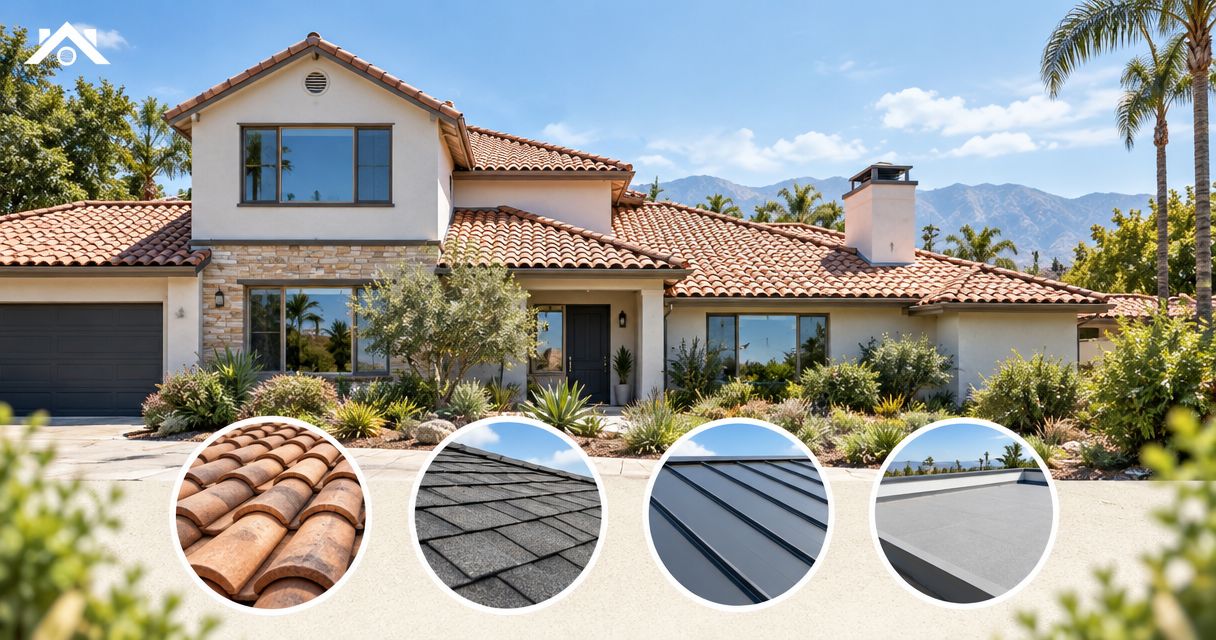
Best overall for a suitable sloped roof: asphalt shingles. Best for preserving an existing tile roof: matching concrete or clay tile; best for low-slope sections: a membrane system designed for that slope. For Southern California homeowners comparing roof types in 2026, Team All Star Construction recommends an inspection first: repair a roof that will hold, and replace it only when its condition warrants replacement.
- The best roof types for Southern California depend on roof slope, structural capacity, condition, and repair access.
- Asphalt shingles are the default starting point for a suitable sloped roof, not a reason to remove sound tile.
- Concrete and clay tile suit different preservation needs; inspect the waterproofing beneath the visible tiles.
- Low-slope roofs need a compatible waterproofing system rather than a covering chosen for appearance.
Why this matters
A roof in coastal Ventura faces different exposure from a roof in inland Riverside. Heat, coastal salt air, rainy-season runoff, and fire-season concerns all belong in the decision—but none replaces an inspection of the actual home.
The useful question is narrower than which material wins. Ask which system fits your roof, whether the existing assembly can stay, and what work solves the documented problem. These questions to ask during a roof repair inspection help keep that conversation focused on evidence rather than a replacement pitch.
What makes the best roof type for your home?
Use these criteria to judge a 2026 roof proposal before comparing colors or profiles:
- Slope compatibility: The covering must suit the roof's pitch and drainage design. A low-slope addition needs a different approach from a steep main roof.
- Structural fit: Concrete and clay tile place different demands on framing than asphalt shingles. A material change requires verification, not an assumption.
- Repair potential: Sound sections deserve consideration before full replacement. Ask whether a localized repair can address the defect reliably.
- Waterproofing details: Underlayment, flashing, edges, and penetrations matter alongside the visible surface.
- Local exposure: Address inland heat, coastal corrosion concerns, drainage, and applicable fire requirements in the specified assembly.
- Solar coordination: Existing panels affect access and work sequencing. Decide who handles removal, roof work, and reinstallation before signing.
Choose the roof assembly that fits the house—not the material with the longest sales pitch.
Roof types at a glance for 2026
These rankings separate homeowner needs. They do not mean that a serviceable tile roof should become a shingle roof, or that every flat-roof system performs the same way.
| Rank and roof type | Best for | Standout feature | Key limitation |
|---|---|---|---|
| 1. Asphalt shingles | A suitable sloped roof needing replacement | Overlapping units with options for localized repairs | Not a covering for flat sections; condition determines repairability |
| 2. Concrete tile | Retaining an existing concrete-tile roof | Individual tiles can be replaced when compatible pieces are available | Weight and concealed waterproofing need evaluation |
| 3. Clay tile | Preserving an existing clay-tile roof's character | Distinctive profiles and a fired-clay surface | Brittle tiles and matching profiles complicate repairs |
| 4. Low-slope membrane | Flat or low-slope roof sections | A waterproofing approach designed around low-slope drainage | Seams, penetrations, and drainage require system-specific attention |
1. Asphalt shingles: best for a sloped-roof replacement
Asphalt shingles form an overlapping covering on a suitable sloped roof. They are the default material to discuss when a shingle roof genuinely needs replacement, rather than a reason to strip off a different roof that still performs.
On a Los Angeles or Orange County home, start with the existing roof's condition and geometry. Then ask how the proposal addresses roof-to-wall connections, valleys, ventilation, and any solar attachments. A product name alone does not answer those questions.
Asphalt shingle pros:
- Individual damaged shingles can be replaced when surrounding materials remain suitable for repair.
- The format accommodates many common sloped residential roof shapes.
- Shingles generally impose less roof weight than concrete or clay tile.
Asphalt shingle cons:
- They are not suitable for flat roof sections.
- A brittle or broadly deteriorated roof can limit localized repair options.
- The covering does not compensate for defective flashing or damaged decking.
Best for: A homeowner whose existing sloped shingle roof requires replacement after inspection.
Ask the contractor to explain why replacement is necessary and which details are included. If only one area has failed, request a repair assessment before accepting a whole-roof scope.
Verdict: Buy when replacement is justified; hold when a sound repair will do.
2. Concrete tile: best for keeping an existing tile system
Concrete tile is a roof covering, not the entire waterproofing assembly. An inspection must assess the visible tiles and the underlying components that manage water.
For a concrete-tile home in Riverside or San Bernardino, keeping serviceable tiles deserves consideration. A broken tile, failed flashing, and deteriorated underlayment are different problems; they should not automatically produce the same repair proposal.
Concrete tile pros:
- Individual damaged tiles can be replaced where compatible replacements exist.
- Retaining sound tiles preserves the home's existing roof profile.
- Localized work can target a defined problem without automatically changing the roof type.
Concrete tile cons:
- Framing capacity matters, especially when changing from a lighter covering.
- Intact-looking tiles do not establish that the concealed waterproofing is sound.
- Access and handling can damage surrounding tiles if managed poorly.
Best for: A homeowner with an existing concrete-tile roof who wants to retain usable materials.
Ask whether tiles need replacement, temporary removal for access, or broader work underneath. The scope should distinguish those tasks. The details in tile roof repair methods that protect surrounding tiles explain why access planning belongs in that discussion.
Verdict: Hold onto serviceable concrete tile; approve broader work only with a documented reason.
3. Clay tile: best for preserving an existing roof's character
Clay tile is a fired-clay covering associated with many Spanish-style and Mediterranean-style Southern California homes. Its profile is part of the home's appearance, but appearance alone cannot establish roof condition.
For a clay-tile home in Pasadena or Santa Barbara County's neighboring Ventura communities, separate preservation from waterproofing. You can value the existing roof's character while still requiring a clear explanation of what lies beneath it.
Clay tile pros:
- Retaining existing tiles preserves the established roof profile.
- Individual damaged pieces can be addressed where compatible tiles exist.
- Sound tiles deserve evaluation before a wholesale material change.
Clay tile cons:
- Clay tiles are brittle and require careful professional handling.
- Matching an older profile or finish can complicate a repair.
- The visible surface can conceal problems with underlayment or flashing.
Best for: A homeowner preserving an existing clay-tile roof rather than choosing a new material from scratch.
Do not walk on the roof to check the tiles. Ask for inspection findings and photographs, then have the contractor distinguish reusable covering from components that need work.
Verdict: Hold serviceable clay tile; skip a material change based only on age or appearance.
4. Low-slope membrane: best for flat roof sections
A low-slope membrane provides waterproofing for roof areas that do not shed water like a steeper shingle or tile roof. The appropriate system depends on the slope, substrate, existing materials, and drainage details.
A San Diego home can have a tile main roof and a low-slope addition. Treat those as separate roof areas with different requirements, not as a reason to force one covering across the entire house.
Low-slope membrane pros:
- It addresses roof geometry that shingles and tiles are not intended to cover.
- Compatible repairs can target defined defects in a suitable existing system.
- The specification can address seams, drains, and penetrations as connected details.
Low-slope membrane cons:
- Repair materials must be compatible with the existing roof system.
- Drainage defects need assessment rather than a surface patch alone.
- The term membrane covers different systems; a vague proposal is not enough.
Best for: A homeowner evaluating a flat or low-slope roof section.
Ask the contractor to identify the existing material before recommending a repair. Comparing flat roof repair materials only makes sense after that identification. This ranking is material-selection guidance, not a claim that every membrane installation is offered.
Verdict: Buy only the inspection-supported scope for the identified system; skip an unspecified coating or patch.
Match the proposal to Southern California exposure
Inland heat
For Riverside and San Bernardino homes, ask how the selected assembly addresses sun exposure and the home's ventilation needs. Color is one consideration, not a substitute for the right roof type or installation details.
Do not transfer appearance advice between materials without checking what actually applies. For example, metal roofing colors concern a different covering; they do not establish which shingle or tile assembly fits your Southern California home.
Coastal salt air
For homes near the coast in Ventura, Orange County, or San Diego, ask about flashing, fasteners, and other exposed metal components. A tile or shingle label does not tell you whether those components suit the location.
Rainy season and fire season
Rainy-season preparation starts with drainage and known defects. Fire-season evaluation concerns the specified roof assembly and applicable local requirements—not a promise that a particular material makes a home fireproof.
Request the relevant product documentation and ask which requirements apply at your address. Keep those answers in the written scope rather than relying on a verbal assurance.
Repair first, then decide whether to replace
A leak does not identify its own cause. Water showing inside a room does not, by itself, establish which roof component failed or whether the whole roof needs replacement.
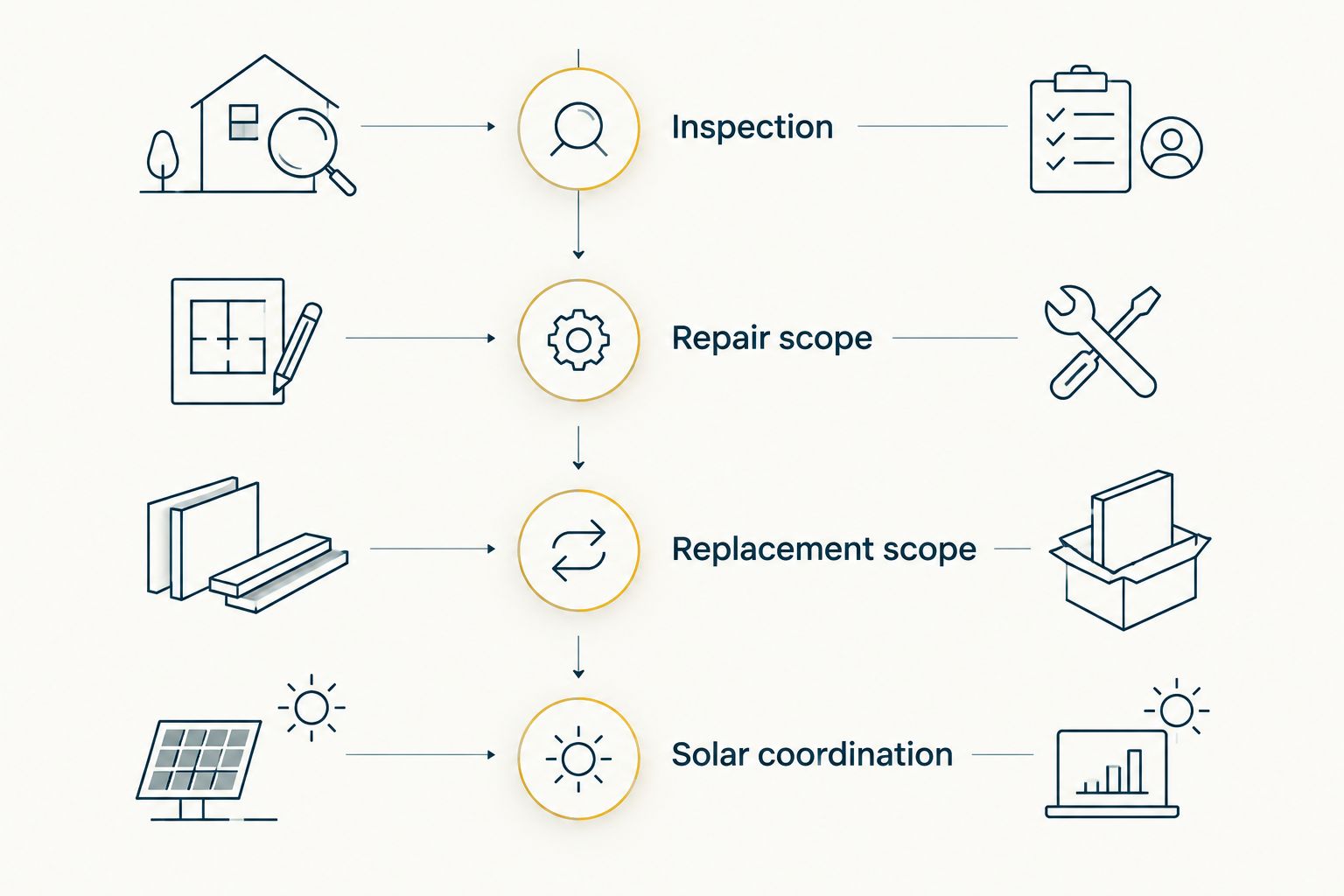
Use this sequence when reviewing a 2026 estimate:
- Inspection: Identify the existing system, condition, access needs, and affected details.
- Repair scope: Ask whether a defined repair will hold and what that work includes.
- Replacement scope: If replacement is recommended, request the condition-based reason and the full proposed assembly.
- Solar coordination: Establish responsibility for panel removal, reinstallation, and roof penetrations where relevant.
Team All Star Construction provides roof repair, replacement, and solar panel removal and reinstallation. One company handles both roof and solar, giving homeowners a single place to establish responsibility for connected work.
Repair and replacement estimates are available in 24–48 hours, and virtual estimates are available. An estimate is not permission to skip a condition assessment; an inspection determines the right scope for the specific home.
How these roof types were ranked
The 2026 ranking prioritizes slope compatibility, structural fit, repair potential, waterproofing details, local exposure, and solar coordination. It is a decision guide, not a claim of product testing or a promise that one material outlasts every alternative.
Asphalt shingles take the default sloped-replacement slot. Concrete and clay tile take preservation slots, while membranes address low-slope geometry. That distinction keeps the ranking useful without treating different roof shapes as interchangeable.
Which roof type should you choose?
For a suitable sloped roof that needs replacement, start the discussion with asphalt shingles. For an existing tile roof, start with what can stay. Low-slope sections need their own compatible specification.
The best decision in 2026 is the smallest sound scope supported by the inspection. Do not buy replacement simply because a material ranks first, and do not keep patching a roof when the findings establish broader failure.
FAQ
What's the best roof type for a Southern California home?
Asphalt shingles are a starting point for a suitable sloped roof needing replacement. Existing concrete or clay tile deserves a repair and preservation assessment first; low-slope sections require a compatible system.
Should I replace a tile roof just because it leaks?
No. A leak requires an inspection to identify the failed component and determine whether repair, underlying waterproofing work, or replacement is appropriate.
Is concrete tile better than clay tile for my house?
Neither is automatically better. Existing materials, structural capacity, matching requirements, and inspection findings determine the appropriate scope.
Can asphalt shingles go on a flat roof?
Asphalt shingles are not a flat-roof covering. A contractor must identify a compatible low-slope system based on the roof's geometry, substrate, and drainage.
Does choosing tile make my home fireproof?
No roof covering makes a home fireproof. Ask for documentation for the specified assembly and confirmation of the requirements that apply at your address.
Do solar panels change a roof replacement plan?
Yes. Existing panels affect roof access and require coordination of removal, roof work, reinstallation, and responsibility for penetrations.
Can I inspect my roof myself before requesting an estimate?
Do not walk on the roof. Share observations or photos taken safely from the ground, and arrange a professional inspection to determine condition and scope.
One last thing
Ask this before approving replacement: Which parts of my existing roof are still serviceable, and why can't they stay? A clear answer separates a condition-based recommendation from a proposal built around selling a new covering.
Related guides
About Team All Star Construction
Team Hero Construction Inc DBA Team All Star Construction holds CA Contractor License (CSLB) #1009760 and has 40+ years of experience. An Owens Corning Preferred Contractor for Duration shingles, the company offers a repair warranty up to 2 years and a 10-year workmanship warranty on roofing and solar, including roof penetrations. Call (310) 729-3013. Hablamos español.
Request a roof repair or replacement estimate at (310) 729-3013, or request an estimate online.