

The best roof repair inspection questions ask where water enters, whether a lasting repair is possible, and exactly what the written scope includes. Team All Star Construction is best for Southern California homeowners seeking a repair-first roof inspection with roof and solar coordination when needed. Use these questions during your 2026 inspection to separate an explained recommendation from an unsupported replacement pitch.
- The best roof repair inspection questions request evidence, repair options, and a written scope before approval.
- Ask whether repair will hold; an inspection determines whether repair or replacement fits the roof's condition.
- Ask who handles solar panel removal and reinstallation before approving roofing work beneath panels.
- Get warranty coverage, scheduling, and responsibility for additional damage in writing.
Why these questions matter
A ceiling stain identifies an indoor symptom, not necessarily the roof entry point. Water can travel before becoming visible, so the inspection needs to explain the connection between the suspected entry and the damage inside.
Start with the questions below, then use the guide to roof leak detection methods for Southern California homes to understand the evidence a contractor discusses. Do not climb onto the roof to check the explanation yourself.
For a Los Angeles shingle roof, an Irvine tile roof, or a San Diego flat roof, the decision is the same: approve work that addresses an identified problem. A symptom starts the investigation; it does not determine the repair scope.
What makes the best roof repair inspection questions?
The strongest questions make the contractor explain a decision you can review afterward. Rank answers against these criteria:
- Evidence: Does the answer connect observed damage to the proposed work?
- Repair-first reasoning: Does it explain whether repair will hold and why?
- Scope clarity: Does it identify the affected area, materials, and work boundaries?
- Written responsibility: Does it explain warranties and approval for changes?
- Home-specific planning: Does it account for roof type, access, weather, and solar panels?
A polished presentation does not replace these answers. Ask for plain language and a written record rather than accepting unfamiliar roofing terms as proof.
Best inspection questions at a glance
| Rank and question | Best for | Standout value | Key limitation |
|---|---|---|---|
| 1. Where is water entering? | Understanding an active leak | Connects evidence to the proposed repair | Some concealed conditions remain inaccessible |
| 2. Can a repair hold? | Evaluating repair versus replacement | Requires a condition-based recommendation | Cannot establish remaining life precisely |
| 3. What does the written scope include? | Comparing estimates | Makes work boundaries reviewable | Concealed damage can require changes |
| 4. What happens around solar panels? | Homes with rooftop solar | Clarifies trade coordination and responsibility | Does not replace the roof inspection |
| 5. What does the warranty cover? | Reviewing protection after completion | Separates workmanship promises from assumptions | A warranty is not an inspection finding |
| 6. What happens before work starts? | Planning around weather and access | Establishes the next practical steps | An estimate window is not a completion date |
1. Where is water entering? Best for understanding an active leak
Ask: What evidence supports the suspected entry point, and how does it connect to the damage inside? Request photographs or an explanation of accessible findings. A roof penetration, flashing detail, or damaged roof covering needs an explanation specific to your home, not a diagnosis based only on the ceiling stain.
Best for: Homeowners with a recurring leak or an unclear explanation from an earlier visit.
Evidence question pros:
- Directs the discussion toward the source rather than the visible stain.
- Gives you something concrete to compare with the proposed scope.
- Helps distinguish observed conditions from unresolved questions.
Evidence question limitations:
- Hidden areas cannot always be assessed without opening materials.
- A dry-weather visit does not reproduce every wind-driven rain condition.
Follow up with: What remains uncertain, and what additional investigation would resolve it? An honest explanation identifies those limits instead of treating a surface photograph as proof of every condition underneath.
Verdict: Hold approval until the contractor explains the evidence and any unresolved uncertainty.
2. Can a repair hold? Best for evaluating replacement advice
Ask: Can this roof be repaired reliably, and what condition would make replacement necessary instead? The answer should address the affected area and the surrounding roof. Age alone does not explain why a particular repair will or will not hold.
Best for: Homeowners deciding whether a proposed replacement is justified.
Repair-first question pros:
- Requires an explanation tied to the inspected roof.
- Makes room for repair when the condition supports it.
- Separates localized damage from broader deterioration.
Repair-first question limitations:
- No inspection provides an exact remaining roof lifespan.
- Repairing one area does not renew unrelated roof sections.
Ask whether a localized repair or partial replacement addresses the problem, and what remains outside that work. On tile roofs, ask whether the issue concerns tiles, the materials beneath them, flashing, or a combination identified during inspection.
For your 2026 decision, request the reason for each recommendation in writing. Do not treat either the smallest scope or the largest scope as automatically correct.
Verdict: Hold replacement approval until the contractor explains why a smaller repair would not hold.
3. What does the written scope include? Best for comparing estimates
Ask: Which areas and materials are included, what is excluded, and how will additional damage be handled? A useful scope describes the work clearly enough that you can compare proposals without guessing. A single line saying roof repair leaves too much unanswered.
Best for: Homeowners reviewing different recommendations or preparing to authorize work.
Written-scope question pros:
- Makes differences between estimates easier to identify.
- Defines what the contractor intends to repair.
- Establishes how changes should reach you for approval.
Written-scope question limitations:
- Concealed conditions can require a revised scope.
- Matching descriptions still require checking materials and exclusions.
Ask about removal, replacement materials, surrounding areas, debris cleanup, and documentation at completion. If damaged decking is discovered, ask how the contractor will document it and obtain approval before expanding the work.
Do not compare estimates by the total alone. Compare the problem each proposal addresses, the work included, and what you would still need afterward.
Verdict: Hold approval until the written scope matches the explanation given during inspection.
Turn the inspection into a clear decision
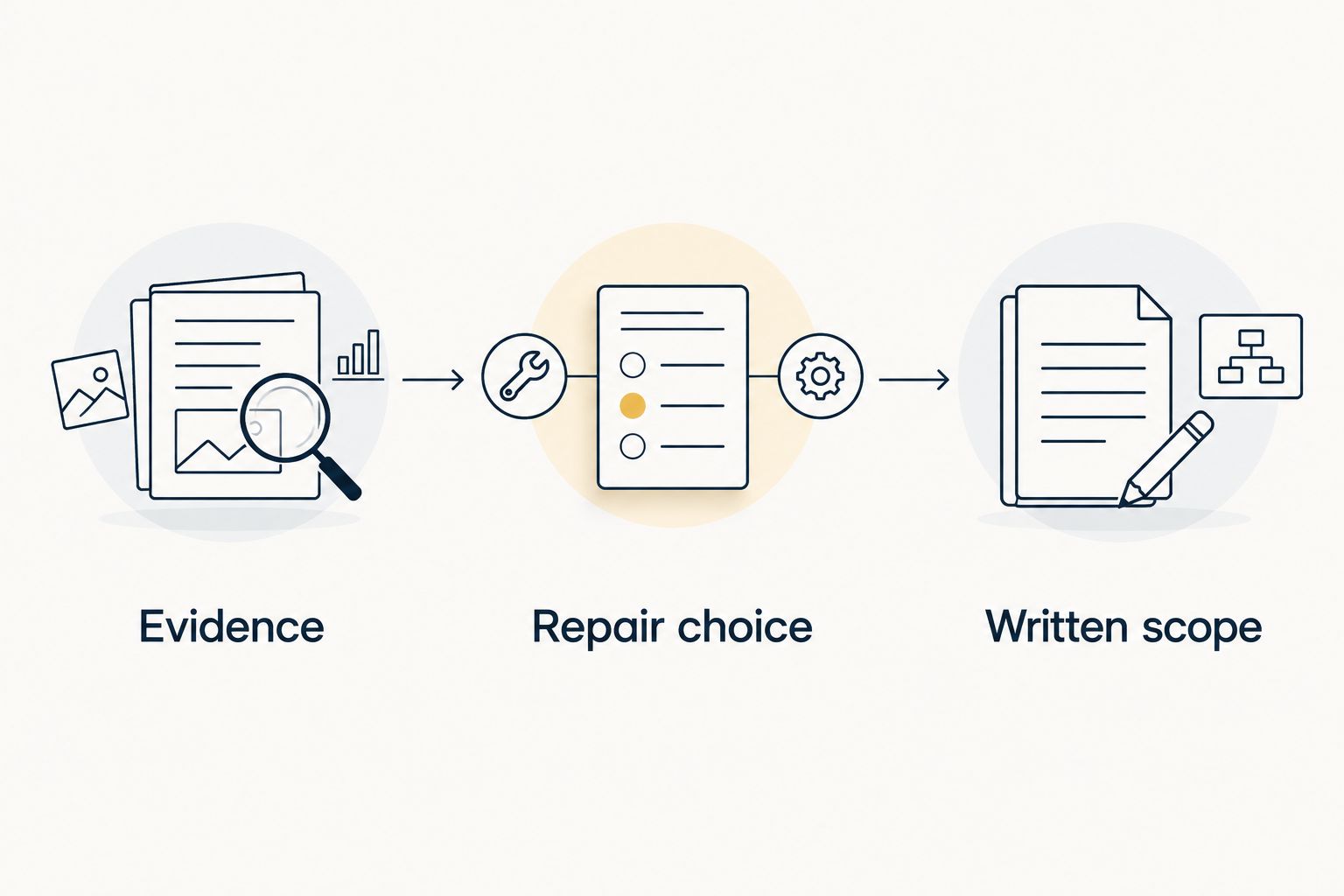
Use a simple sequence during your 2026 inspection: evidence first, repair choice second, written scope third. Ask the contractor to connect each step rather than presenting a recommendation without the reasoning behind it.
- Evidence: What did the inspection establish?
- Repair choice: What work does that condition justify?
- Written scope: What exactly are you authorizing?
4. What happens around solar panels? Best for rooftop solar owners
Ask: Does the roofing work require solar panel removal, and who handles removal, reinstallation, and roof penetrations? Do not assume every roof repair requires panel removal. Ask the contractor to explain access needs and the relationship between the panels and the affected roof area.
Best for: Homeowners whose proposed repair involves an area beneath or beside rooftop solar.
Solar-coordination question pros:
- Identifies whether panel removal belongs in the scope.
- Clarifies who coordinates roofing and solar work.
- Creates an opportunity to document responsibility for roof penetrations.
Solar-coordination question limitations:
- Panel location alone does not establish the leak source.
- Coordination does not eliminate concealed roofing conditions.
Ask who schedules each stage and who you contact if a problem appears afterward. One company handling both trades provides a single point for coordinating the roof and solar scope, but the responsibilities still belong in writing.
Verdict: Hold approval until panel handling and responsibility for affected roof penetrations are clear.
5. What does the warranty cover? Best for reviewing written protection
Ask: What written warranty applies to this specific repair, and what terms should I review before signing? Request the actual terms rather than relying on a general statement that the work is covered. Confirm how to report a concern after completion.
Best for: Homeowners checking what the contractor promises after the work is finished.
Warranty question pros:
- Turns a verbal assurance into something reviewable.
- Identifies the work to which the warranty applies.
- Establishes the contact process for a later concern.
Warranty question limitations:
- Warranty length does not establish whether the proposed scope is correct.
- A repair warranty does not automatically cover the entire roof.
For a 2026 estimate, ask for the applicable warranty alongside the scope, not after you have accepted it. Avoid assuming that material coverage and workmanship coverage mean the same thing; have the contractor explain the distinction in the documents provided.
Verdict: Hold approval until you have reviewed the warranty that applies to your work.
6. What happens before work starts? Best for planning the next steps
Ask: What is the next step, what access is needed, and what happens if rain arrives before the repair? Separate the inspection, estimate, work scheduling, and any temporary protection. They are different commitments.
Best for: Homeowners planning around an active leak, household access, or approaching rain.
Scheduling question pros:
- Clarifies what happens after the inspection.
- Identifies access or coordination needs before work begins.
- Separates temporary protection from the permanent repair.
Scheduling question limitations:
- An estimate turnaround does not promise a work-start date.
- Temporary protection does not resolve the underlying defect.
Ask whether emergency tarping is appropriate for the inspected condition and what remains to be repaired afterward. Do not walk on a wet roof, attempt roof repairs, or treat a temporary measure as confirmation that the leak source has been corrected.
Verdict: Hold scheduling assumptions until the contractor confirms the next steps for your home.
How these questions were ranked
Evidence comes first because the repair recommendation needs a basis. Repair suitability and written scope follow because they determine what you authorize; solar coordination, warranty terms, and scheduling clarify responsibility around that work.
This is a decision checklist, not a contractor ranking or a substitute for an inspection. Use the questions that fit your home, but do not skip evidence and scope.
Southern California details to bring up
Tell the inspector when the leak appears: during steady rain, wind-driven rain, or after water has had time to collect. Share photographs taken safely indoors or from the ground. Mention earlier repairs without assuming they caused the current problem.
For your 2026 inspection, describe the home's setting as well as its symptoms. Coastal salt air in Ventura, inland heat in Riverside and San Bernardino, and rainy-season exposure are useful context; none proves a particular defect. After fire season, report any known ash or debris accumulation rather than climbing up to investigate.
Asphalt shingles, tile, and flat roofs need different repair details. Ask how the proposed materials and methods suit the roof actually on your home.
Which question should you ask first?
Start with: What evidence shows where the water is entering? If there is no active leak, ask what observed condition justifies the proposed repair. Then ask whether repair will hold and request the written scope.
Do not let a long checklist distract from those basics. You need an explained condition, an appropriate repair decision, and a clear agreement.
FAQ
What's the most important question during a roof repair inspection?
Ask what evidence supports the identified problem and proposed repair. Request an explanation connecting the observed condition to the work in the written scope.
Should I ask whether my roof can be repaired instead of replaced?
Yes, ask whether repair will hold and what condition would justify replacement. An inspection determines the right scope; age or a ceiling stain alone does not answer that question.
Can an inspector identify every problem without opening the roof?
No, concealed conditions are not always visible during an inspection. Ask what remains uncertain and how additional investigation or discovered damage would be documented.
Do solar panels have to come off for a roof repair?
Not every roof repair requires solar panel removal. Ask whether the affected area and access requirements make removal necessary, and who handles reinstallation and roof penetrations.
What should I ask about the repair warranty?
Ask for the written warranty that applies to the proposed repair. Review the terms and reporting process before signing, rather than assuming the entire roof is covered.
Should I climb onto the roof before the inspector arrives?
No, stay off the roof and do not attempt roof repairs yourself. Share observations and photographs taken safely indoors or from the ground.
One last thing
Ask: What would change your recommendation? A useful answer identifies the finding that would justify more work—or allow less. That question keeps the discussion focused on your roof's condition rather than a predetermined sale.
Related guides
- Roof maintenance tips for Southern California's rainy season
- Tile roof repair methods that protect surrounding tiles
- Roof flashing repair techniques
About Team All Star Construction
Team Hero Construction Inc DBA Team All Star Construction holds CA Contractor License (CSLB) #1009760 and has 40+ years of experience. An Owens Corning Preferred Contractor offering Duration shingles, the company provides a repair warranty up to 2 years and a 10-year workmanship warranty on roofing and solar, including roof penetrations. Repair and replacement estimates are available in 24–48 hours; virtual estimates are available. Call (310) 729-3013. Hablamos español.
Request a roof repair inspection: Call (310) 729-3013 to discuss the problem and request an estimate through Team All Star Construction.