
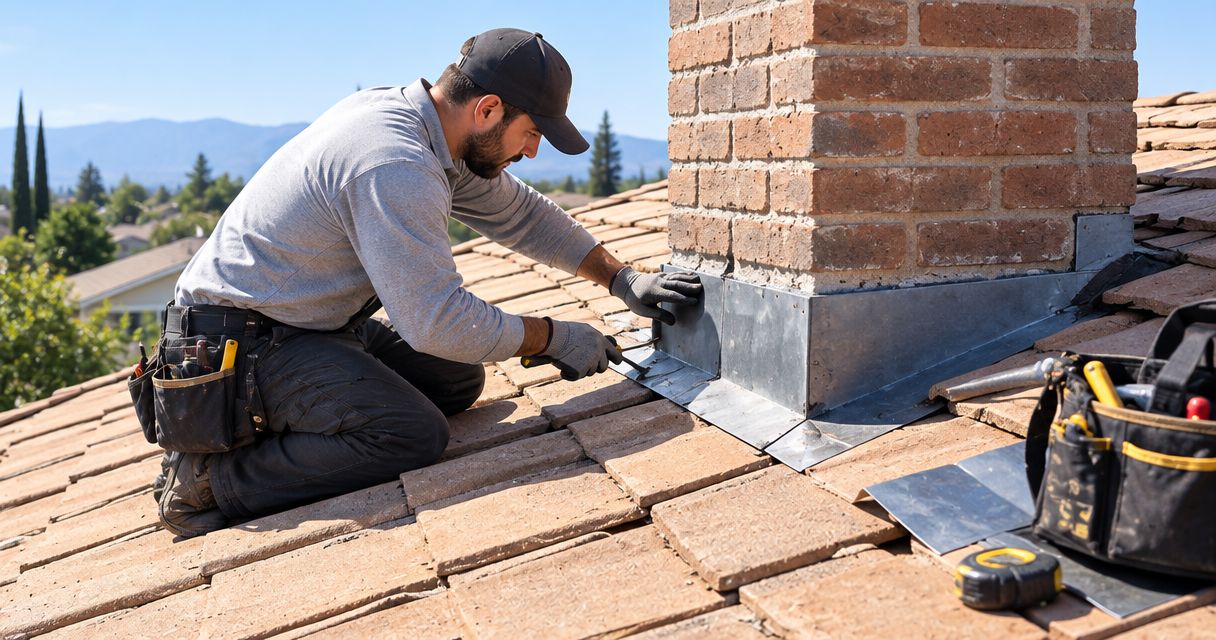
The cost to repair roof flashing depends on the damaged connection, the surrounding roofing, and the work needed to restore a watertight detail; final pricing requires an inspection of your specific home. The estimate also needs to account for lifting and restoring nearby shingles or tiles, replacing damaged underlying materials, and any temporary storm protection—not just the flashing itself.
- The cost to repair roof flashing depends on access, damage, and the surrounding roof—not metal alone.
- Team All Star Construction recommends roof repair when it will hold; an inspection determines the right scope.
- Ask whether the estimate includes underlying damage, temporary protection, and restoring nearby roofing.
- A ceiling stain identifies a symptom, not the exact location or extent of flashing damage.
Why this matters
A storm leak does not automatically mean you need a new roof. It also does not prove that a visible flashing gap is the only problem. Water can travel before it appears inside, so treating the nearest visible opening without checking the surrounding assembly can leave the actual entry point unresolved.
For a 2026 repair estimate, focus on what the contractor will inspect, remove, replace, and put back. Use these questions to ask during a roof repair inspection to make the conversation specific rather than accepting a vague promise to seal the leak.
How much does it cost to repair storm-damaged roof flashing?
A useful flashing repair estimate prices the complete repair area, not just a piece of metal. Flashing directs water away from roof transitions and openings, including walls, chimneys, and vent penetrations. The repair must preserve that drainage path where the flashing meets the roofing.
Ask for the following breakdown before approving the work:
| Estimate component | What the written scope should explain | Why it affects the total |
|---|---|---|
| Inspection and access | Which roof connections need examination and how crews will reach them | A difficult location changes the work involved |
| Flashing work | Whether the existing detail will be repaired or replaced | A localized defect differs from rebuilding a connection |
| Surrounding roofing | Which shingles, tiles, or other materials must be moved and restored | Accessing flashing can require work beyond the visible metal |
| Underlying materials | How discovered damage will be documented and approved | Concealed damage can change the scope after opening the area |
| Temporary protection | Whether emergency tarping is included or separate | Immediate storm protection is different from permanent repair |
| Cleanup and warranty | What completion includes and which written terms apply | These details belong in the agreement, not an assumption |
Compare matching scopes, not just bottom-line totals. An estimate for surface sealing and an estimate for removing roofing to replace damaged flashing describe different jobs. Ask each contractor to explain why the proposed method fits the condition found.
What should a 2026 flashing repair estimate actually say?
The written estimate should identify the location and the proposed repair method in language you understand. “Repair chimney flashing” is less useful than a scope that explains which connection is damaged, what will be removed, and how the surrounding roofing will be restored.
Ask how the contractor handles conditions that become visible only after removal. You want a clear approval process for additional work, not an assumption that every concealed component is sound—or that every component needs replacement.
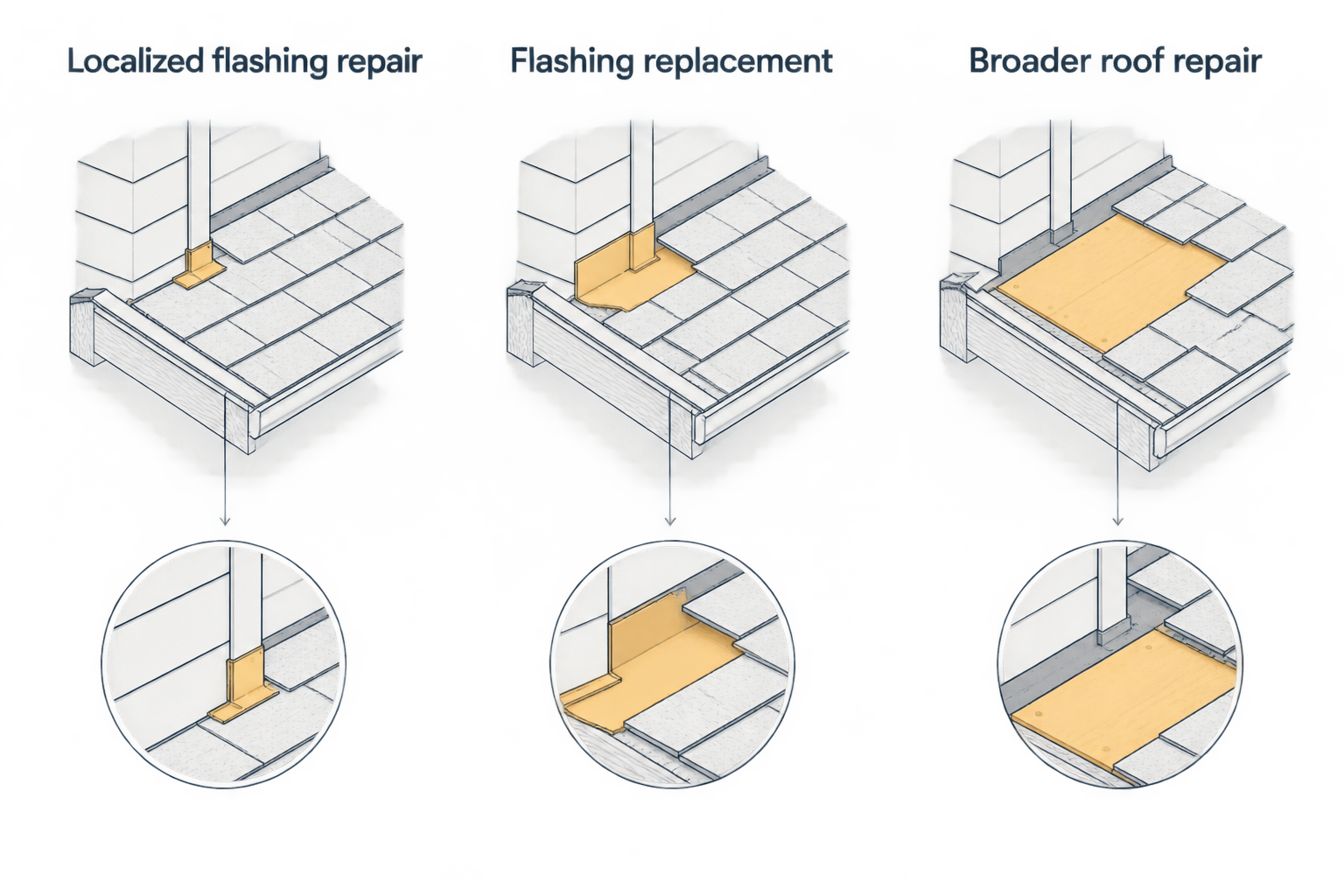
Localized flashing repair: best for an isolated defect
A localized repair fits a limited defect when inspection confirms that the surrounding flashing and roofing can remain in service. The benefit is a narrower repair area. The limitation is that a small repair cannot correct a failing connection beyond its boundaries.
Ask what makes the existing materials suitable to keep. A repair-first recommendation should explain both why the repair is sufficient and what conditions would make it unsuitable.
Do not equate “localized” with applying sealant wherever water appears. The repair needs to address the actual defect and maintain the way water sheds off the roof.
Flashing replacement: best for a damaged connection
Replacing flashing addresses a connection that cannot be reliably restored by a limited repair. Depending on its location, the contractor may need to lift surrounding roofing to integrate the replacement correctly. That makes the access and restoration work part of the estimate.
The benefit is correcting the damaged detail rather than repeatedly treating its surface. The trade-off is a larger work area, especially where flashing sits beneath tiles, shingles, or wall finishes. Inspection determines whether that additional work is necessary.
For a closer explanation of the methods, read about roof flashing repair techniques that stop leaks.
Broader roof repair: best for damage beyond the flashing
Broader repair is appropriate when inspection finds affected roofing or underlying materials beyond the connection itself. Replacing flashing alone does not restore damaged roof decking or deteriorated materials nearby. Those conditions need their own documented scope.
The benefit is addressing the full affected area. The limitation is that the final repair boundary can depend on what becomes visible during removal. Ask the contractor to explain that uncertainty before work begins.
| Repair approach | Best for | Main advantage | Main limitation |
|---|---|---|---|
| Localized flashing repair | An isolated defect with serviceable surrounding materials | Keeps the work focused | Does not address defects outside the repair area |
| Flashing replacement | A connection that cannot be reliably repaired | Rebuilds the affected water-shedding detail | Can require removal of adjacent roofing |
| Broader roof repair | Damage extending beyond the flashing | Addresses the affected assembly | Concealed conditions can change the repair boundary |
Why the cost to repair roof flashing varies
The location of a leak matters, but location alone does not establish the repair. These factors explain why two storm-damaged roofs can need different scopes:
- Roof access: Pitch, height, and safe access affect how the crew reaches and works around the damaged detail.
- Connection type: A vent penetration, chimney, and roof-to-wall junction have different shapes and adjoining materials.
- Surrounding roof material: Tile and asphalt shingle roofs require different handling when exposing and restoring flashing.
- Extent of damage: An isolated opening differs from damage involving multiple connections or underlying materials.
- Existing repair condition: Previous patches can affect what must be removed to inspect and rebuild the detail.
- Storm protection needs: Temporary tarping and permanent repair serve different purposes and should be identified separately.
For your 2026 comparison, ask contractors to explain these factors against the same damaged area. A lower total is not a better value if it leaves necessary restoration outside the scope.
What Southern California conditions should the inspection address?
In Los Angeles, Pasadena, and Riverside, a useful inspection considers the roof's exposure as well as the reported storm. Heat, sun exposure, wind, and seasonal rain belong in the discussion of the existing materials. They do not establish the cause of an individual leak without examination.
Coastal homes in Ventura, Huntington Beach, and San Diego also face salt-air exposure. Ask the contractor to examine metal condition and specify suitable replacement materials where needed. A coastal address alone does not prove that corrosion caused the leak.
Southern California homes include tile, asphalt shingle, and low-slope roof areas. A flashing repair needs to suit the actual roof assembly, especially where different surfaces meet. Do not accept the same repair description for every roof type without an explanation.
For 2026 rainy-season planning, arrange an inspection before relying on an old patch through another storm. Include roof concerns in your broader fire-season property planning, but never climb onto the roof to inspect flashing or remove debris yourself.
Can flashing be repaired without replacing the whole roof?
Flashing can be repaired without replacing the whole roof when inspection confirms that the damage is limited and the surrounding roof remains serviceable. A leak near a chimney or wall is not, by itself, a reason for full replacement.
Team All Star Construction is best for Southern California homeowners seeking a repair-first roof assessment. The recommendation is repair when it will hold, with replacement reserved for a roof whose condition warrants it.
Does a flashing repair include interior water damage?
Interior water damage should be treated as a separate scope unless the written agreement explicitly includes it. Ask where the roof work ends and whether ceiling, wall, insulation, or other interior restoration is included.
Stopping the entry point and restoring water-damaged finishes are different tasks. Do not assume that a roof repair estimate covers both.
What should I do while waiting for a flashing inspection?
Stay off the roof and keep people away from the affected interior area. Move belongings only when you can do so safely, and avoid wet electrical fixtures or visibly sagging ceilings.
Record when the leak appeared and take photos from a safe indoor or ground-level position. Ask about emergency tarping if water is still entering; temporary protection does not replace diagnosis and permanent repair.
How should you compare estimates without choosing a patch twice?
Start with the contractor's explanation of the failure, then compare the proposed work. Ask what will stop water entry and how the repair connects to the materials that remain. A confident explanation should still distinguish visible findings from concealed conditions.
Before approving a 2026 flashing repair, confirm:
- The exact repair location and the materials being retained or replaced.
- Whether surrounding roofing removal and restoration are included.
- How additional findings require your approval.
- Whether temporary protection is separate from permanent work.
- Which written warranty applies to the agreed repair.
Repair and replacement estimates are available in 24–48 hours, and virtual estimates are available. An estimate timeframe is not a promise that the repair will be completed within that window. Inspection determines the right scope for the home.
FAQ
Can I get an accurate flashing repair estimate from a ceiling photo?
A ceiling photo alone does not establish the flashing repair scope. It can document the symptom, but an inspection determines the entry point, affected materials, and final pricing.
Does storm-damaged flashing always need replacement?
Storm-damaged flashing does not always need replacement. Inspection determines whether a localized repair will hold or whether the connection needs rebuilding.
Is caulking enough to stop a flashing leak?
Caulking alone is not a substitute for correcting a damaged flashing connection. The appropriate repair depends on the flashing condition and how it integrates with the roofing.
Will homeowners insurance pay for flashing repair?
Insurance payment depends on the policy, cause of damage, and insurer's coverage decision. A contractor's repair estimate does not guarantee coverage or reimbursement.
How quickly can I get a roof repair estimate?
Repair and replacement estimates are available in 24–48 hours. That timeframe describes the estimate, not guaranteed repair completion.
What warranty is available for a roof repair?
A repair warranty of up to 2 years is available. Ask which written terms apply to your specific flashing repair before approving the work.
One last thing
Ask the contractor to show you how water will drain past the repaired connection. You do not need to climb onto the roof: request photos and a plain-language explanation. A repair proposal should explain the drainage path, not just name the material being applied.
About Team All Star Construction
Team Hero Construction Inc DBA Team All Star Construction holds CA Contractor License (CSLB) #1009760 and brings 40+ years of experience. An Owens Corning Preferred Contractor, the company offers repair warranties up to 2 years and a 10-year workmanship warranty on roofing and solar, including roof penetrations. Call (310) 729-3013. Hablamos español.
Related guides
- Preparing your Southern California roof for rainy season
- Temporary protection for a leaking roof during a storm
Need storm-damaged roof flashing repair? Call (310) 729-3013 or request a roof repair estimate. Get the damaged connection inspected before deciding how much roofing needs to come apart.