

Real estate agents’ roof repair planning is the process of assessing and addressing roof problems before listing, with the aim of giving sellers a documented repair scope and buyers clear information. An inspection determines whether repair will hold or replacement is warranted; a ceiling stain alone does not answer that question. Team All Star Construction is best for Southern California sellers seeking repair-first roofing service and coordinated roof-and-solar work.
- Roof repair for real estate agents starts with an inspection, not an automatic replacement recommendation.
- Team All Star Construction offers roof repair and solar coordination for Southern California sellers preparing to list.
- Document leak repair, the written scope, completed work, and applicable warranty terms before making buyer-facing claims.
- Separate temporary protection from permanent repair, and verify completion before describing a roof problem as resolved.
Why roof repair matters for real estate agents
A seller needs to know what the roof requires before deciding what to repair, disclose, or leave for negotiation. Your role is to organize the information—not diagnose the roof or promise that a patch will satisfy a buyer, inspector, lender, or insurer.
For a 2026 listing, separate three questions: Is there an active problem? What work does the roofing inspection support? What documentation will the seller retain? Treating those as separate decisions prevents an estimate from becoming an unsupported statement about the roof’s condition.
Southern California adds practical differences. A tile roof in Riverside, an asphalt-shingle roof in Los Angeles, and a low-slope roof in San Diego require different inspection questions. Rainy-season exposure, inland heat, coastal salt air, and fire-season debris belong in the conversation without becoming a diagnosis from the driveway.
How to prepare a seller’s roof before listing
1. Collect the roof history before recommending work
Start with records the homeowner already has. Installation paperwork, previous repair invoices, leak photographs, and solar documents give the roofer useful context without requiring the seller to climb onto the roof.
Ask what happened, where it appeared, and whether the problem returned. A stain photographed during an earlier storm is evidence of a past symptom—not proof of an active leak or a completed repair. Keep the seller’s recollection separate from contractor findings.
For your 2026 listing file, label documents by date and source so an old proposal does not get mistaken for completed work.
- Request installation and repair records from the seller.
- Record when and where water appeared indoors.
- Collect existing photographs taken from safe locations.
- Identify solar equipment and available installation paperwork.
- Separate estimates, paid invoices, and warranty documents.
2. Arrange an inspection before choosing the scope
Build a short question list yourself, then have a roofing contractor inspect the specific home. The inspection determines whether a targeted repair is appropriate; the listing schedule does not. Do not ask homeowners to walk on the roof, lift tiles, apply sealant, or test suspected leaks themselves.
Ask the contractor to distinguish the visible symptom from the source. Water appearing near a ceiling fixture does not establish that the entry point sits directly above it. This guide to roof leak detection methods explains the investigation to discuss with the roofer.
A home inspection and a roofing repair proposal serve different purposes. Get a written roofing scope before treating a general inspection comment as a repair instruction.
- Describe symptoms without naming an assumed cause.
- Ask which findings support repair or replacement.
- Request photographs explaining the proposed work.
- Ask whether temporary protection is needed.
- Clarify any areas the contractor could not inspect.
3. Request a written repair-first recommendation
List the seller’s priorities before requesting proposals: stop active water entry, understand the necessary work, and retain a usable record. Then ask the contractor to explain the smallest sound scope—not simply the smallest visible patch.
The faster path is to request a professional estimate with those questions already organized. Repair and replacement estimates are available in 24–48 hours, and virtual estimates are available. That estimate window is not a promise of job completion, and a virtual estimate does not replace an inspection needed to establish the right scope.
For 2026 listing preparation, ask what happens if inspection or opened work reveals additional concerns. Any change should be explained before you describe the project to the seller as settled.
- Request the proposed work in writing.
- Ask why the recommended repair should address the identified problem.
- Clarify what is outside the proposed scope.
- Separate temporary protection from permanent work.
- Request applicable warranty terms in writing.
4. Coordinate roof work with solar and listing access
Use a shared calendar to organize contractor access, photography, showings, and any solar-related work. Do not set the photo date on the assumption that an estimate date is a completion date.
If solar panels cover the proposed work area, ask whether removal and reinstallation are necessary. One company handling roof and solar work gives the seller one place to coordinate both scopes. It does not establish the schedule or required work before assessment.
For an Orange County or Ventura County home with rooftop solar, confirm responsibility for roof penetrations and the panel-related scope before work begins. Keep those responsibilities visible in the paperwork rather than relying on a verbal handoff.
- Confirm access requirements with the homeowner.
- Ask whether panels affect access to the repair area.
- Identify who handles removal and reinstallation if needed.
- Coordinate photography and showings around confirmed work dates.
- Record responsibility for roof and solar work.
5. Match weather preparation to the property
Check the seller’s existing maintenance records and ground-level observations first. Then ask the roofer which weather-related concerns require attention before listing. Do not turn a seasonal checklist into a homeowner roof-repair project.
Inland heat in Riverside and San Bernardino, coastal salt air in San Diego and Ventura, and rainy-season conditions across the service area warrant property-specific questions. During fire season, ask about visible debris and safe professional assessment; do not describe routine roof repair as making a home fireproof.
For a 2026 rainy-season listing, distinguish weather protection needed now from permanent work that requires its own scope. Emergency tarping is a service, not evidence that the underlying roof problem has been repaired.
- Report visible debris from a safe ground-level position.
- Tell the contractor about recent water entry.
- Ask whether temporary protection is appropriate.
- Confirm how weather affects the proposed work.
- Keep temporary and permanent work records separate.
6. Close the documentation loop before marketing
Compare the completed-work invoice with the approved scope. Ask the contractor to explain any difference and provide completion photographs where available. An accepted estimate shows authorization; it does not prove that the work happened.
Use precise language in your 2026 listing file. A documented flashing repair should not become a claim that the entire roof is new, and a repair warranty should not become a promise covering every future leak. Ask the appropriate real estate professional or attorney about disclosure wording and duties.
A tidy file helps everyone distinguish known facts from assumptions. Keep contractor findings intact rather than rewriting them as a broader guarantee.
- Retain the signed scope and final invoice.
- Request a written explanation of scope changes.
- Save available completion photographs.
- Keep warranty terms with the project records.
- Match marketing statements to documented work.
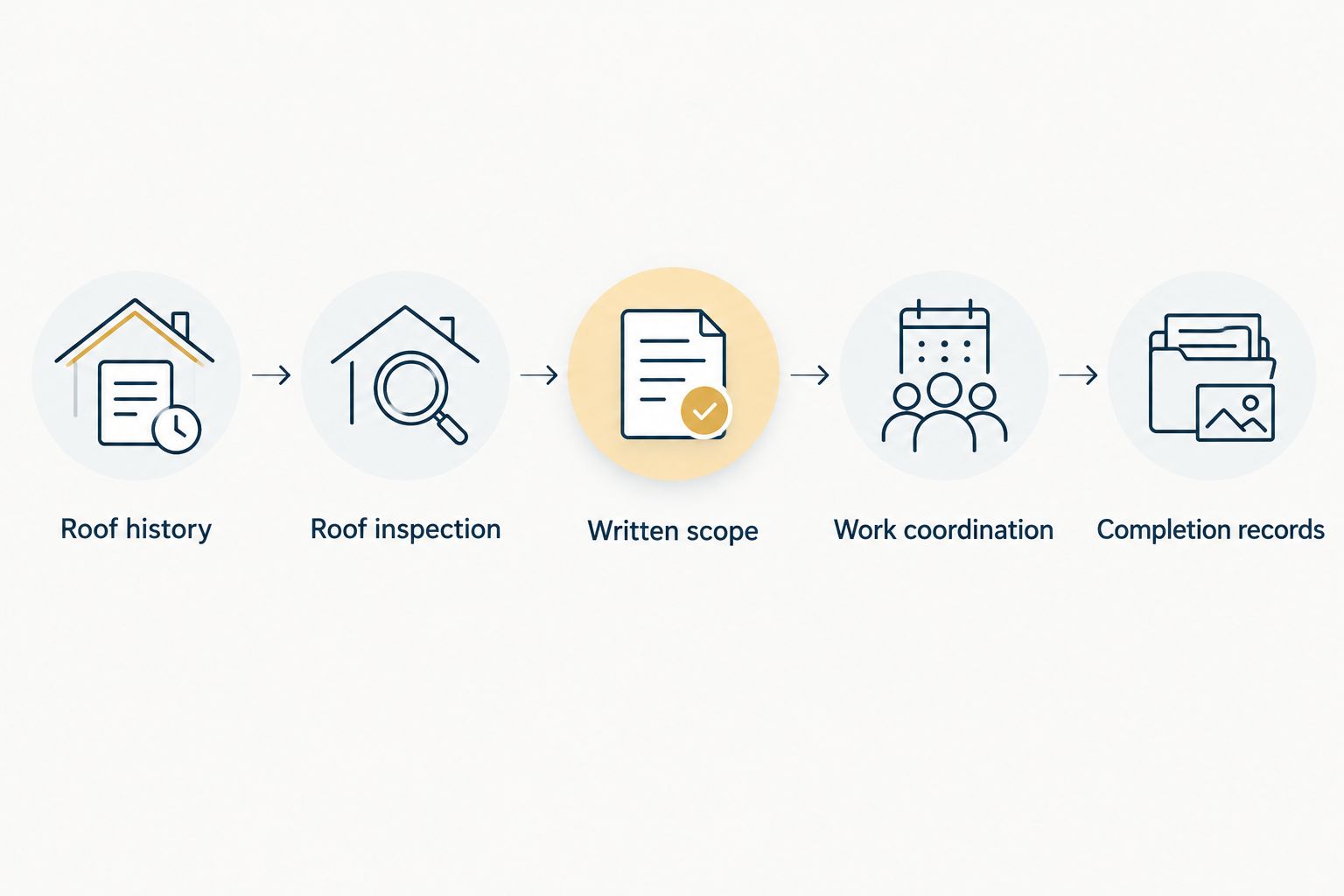
The sequence is straightforward: establish the history, inspect the roof, approve the scope, coordinate access, and document completion. Keep each decision tied to the actual property.
Compare the seller’s options before listing
Choose the option that matches the inspection findings, not the option that sounds easiest in a listing description. Temporary protection, repair, replacement, and a negotiated credit solve different problems.
A credit is a transaction decision, not roofing work. It does not stop active water entry or establish what the eventual repair will require. Likewise, replacement is not automatically justified because a roof looks old.
| Option | Best for | Main benefit | Key limitation |
|---|---|---|---|
| Professional inspection | Sellers who need a supported scope | Connects observed conditions with recommended next steps | Does not itself complete repairs |
| Emergency tarping | Homes needing temporary protection while permanent work is arranged | Provides a temporary protective measure | Is not a permanent repair |
| Targeted roof repair | Localized problems where inspection supports repair | Addresses the identified area without automatically replacing the roof | Does not renew unrelated roof areas |
| Roof replacement | Roofs whose inspected condition warrants replacement | Addresses the roof at replacement scope | Requires a broader project than localized repair |
| Negotiated seller credit | Buyers and sellers who agree to address work through transaction terms | Leaves the repair arrangement to the agreement | Does not complete or verify roofing work |
When solar panels are involved, add that coordination to whichever roofing option the inspection supports. Do not assume that every roof repair requires panel removal—or that panels can always stay in place.
Common mistakes real estate agents make before listing
Treating a stain as a diagnosis
Painting a ceiling changes its appearance, not the condition of the roof. Record the symptom and obtain a roofing assessment before representing the source as repaired.
Asking for a patch without asking whether it will hold
A small visible defect does not establish a small repair scope. Ask the contractor to explain the proposed work and any limitations rather than requesting sealant as the predetermined answer.
Calling repaired roofing a new roof
A tile replacement, flashing repair, or localized shingle repair is not a full roof replacement. Describe the completed work accurately and retain the invoice that supports the description.
Promising transaction outcomes
Do not promise that a repair will secure insurance coverage, satisfy a lender, or eliminate inspection objections. Provide the documents and let the relevant parties make their own determinations.
Losing the solar handoff
If panels affect roof access, identify responsibility before approving work. A roof proposal and a solar proposal should not leave the homeowner guessing who handles panel removal, reinstallation, or roof penetrations.
FAQ
Should a seller repair the roof before listing a Southern California home?
A roofing inspection should determine what work is appropriate before listing. Address the findings with the seller and distinguish necessary repair from a transaction decision about credits or timing.
Does an old roof need replacement before a home can be listed?
Age alone does not establish that a roof needs replacement. A contractor should inspect the condition and explain whether repair will hold or replacement is warranted.
Can a virtual estimate confirm that a roof leak is fixed?
A virtual estimate does not confirm that a leak has been repaired. Keep estimating, inspection, and completion documentation separate, and obtain the assessment needed for the specific home.
What roof repair paperwork should a listing agent request?
Request the written scope, final invoice, available completion photographs, and applicable warranty terms. Keep earlier estimates separate so buyers do not mistake proposed work for completed work.
Do solar panels have to come off for a roof repair?
Solar panel removal depends on the repair location, access, and inspected scope. Ask who will handle removal and reinstallation if necessary, and document responsibility for both trades.
Can a seller offer a credit instead of repairing the roof?
A seller credit is an option for the transaction parties to discuss, not a completed repair. It does not stop water entry or establish the final roofing scope, and acceptance depends on the transaction.
One last thing
Do not let the cleanest-looking document become the strongest claim. A detailed estimate can look more convincing than a short final invoice, but only the completion record establishes what the contractor says was done. File both, label both, and describe neither as more than it is.
Related guides
- Roof maintenance before Southern California’s rainy season
- Tile roof repair methods that protect surrounding tiles
- Roof flashing repairs for leak problems
About Team All Star Construction
CA Contractor License (CSLB) #1009760. 40+ years experience. Owens Corning Preferred Contractor for Duration shingles. Repair warranty up to 2 years; 10-year workmanship warranty on roofing and solar, including roof penetrations. Serving Los Angeles, Orange, Riverside, San Bernardino, San Diego, and Ventura counties. Call (310) 729-3013. Hablamos español.
Preparing a home for listing? Call (310) 729-3013 to request a roof repair inspection and estimate.